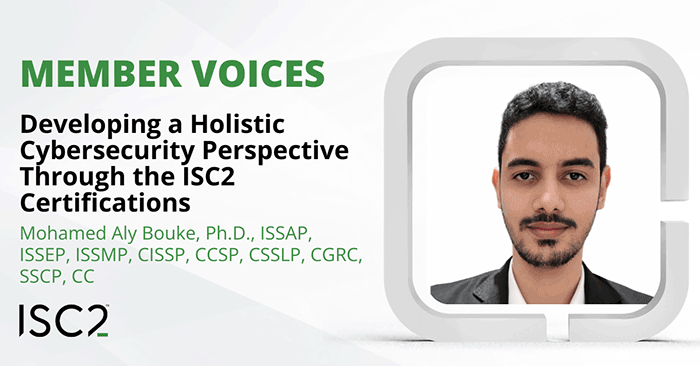
Hear from Mohamed Aly Bouke, Ph.D., IEEE Senior Member, ISSAP, ISSEP, ISSMP, CISSP, CCSP, CSSLP, CGRC, SSCP, CC about how he took on the challenge of earning all nine ISC2 credentials. Learn about his career progression, from forensic science aspirations to software development, penetration testing, research and eventually being an Authorized ISC2 Instructor.
Disclaimer: The views and opinions expressed in this article belong solely to the author and do not necessarily reflect those of ISC2.
 Cybersecurity today is no longer a narrow technical specialty; it has evolved into an integrated discipline where engineering, cryptography, risk management, governance, architecture, and strategic decision-making converge. Developing a meaningful understanding of this ecosystem requires more than a single technical viewpoint or a single certification; it requires a holistic perspective that connects system design, adversarial behavior, organizational context, and strategic risk. This way of thinking was not present at the beginning of my career. It emerged gradually, shaped by both my personal professional choices and by the broader transformation of the cybersecurity landscape itself.
My first encounter with the field dates to 2010, when I was introduced to the CISSP certification. At that time, I was still at an early stage of my professional journey, and what attracted me primarily was the reputation of CISSP as a symbol of rigor and trust in information security, rather than a full understanding of its strategic scope. This period also coincided with a pivotal shift in cyber threats. The disclosure of Stuxnet, the rise of advanced persistent threats, and the growing exploitation of application-layer vulnerabilities marked a transition from viewing cybersecurity as a supporting IT function to recognizing it as a strategic and even geopolitical domain.
An Analytical and Adversarial Way of Thinking
Before fully committing to cybersecurity, my intellectual interests had been oriented toward forensic science and criminal investigation. I was drawn to analytical reasoning, evidence reconstruction, and understanding adversarial intent. When a medical forensic path was no longer feasible, cybersecurity presented itself as the closest scientific and practical field in which the same investigative mindset could be applied, this time in the digital domain, through incident analysis, attack reconstruction, and the protection of critical systems. In this sense, my choice of cybersecurity was not a departure from an earlier aspiration, but a natural continuation of the same analytical and adversarial way of thinking within a technological context.
My professional entry point was software development. I was motivated by a desire to understand how systems are built from the inside: how architectural decisions are made, how components interact, and how design assumptions shape reliability and security. Working at the code and architecture level revealed that many security weaknesses are not the result of isolated bugs, but of structural and conceptual decisions made early in the design process. At the same time, the evolving threat environment and the growing visibility of real-world breaches made it clear that understanding construction alone was insufficient. To fully grasp the security problem, one also had to understand how systems are deliberately and systematically broken.
My transition into penetration testing was, therefore, both a conscious decision and a response to the opportunities emerging in a rapidly expanding cybersecurity market. Organizations were increasingly seeking professionals who could think like attackers, as well as designers. Moving into an offensive, hands-on role allowed me to complement my development background with an adversarial perspective; to observe how theoretical security assumptions fail under realistic conditions, and to understand how vulnerabilities arise from the interaction between design, implementation, and operational constraints. This shift was less a change of direction than an expansion of perspective from building systems to stress-testing their trust boundaries.
These early stages, shaped by technological and threat evolution of that era, laid the conceptual foundation for how I approach cybersecurity today: as a discipline that must be understood simultaneously from the viewpoints of the architect, the attacker, and the analyst.
From Academic Research to Education and Consulting
My path then extended into academic research, supported by a background in mathematics and a growing interest in the theoretical foundations of security. This led to work in areas such as intrusion detection, data leakage prevention, adversarial machine learning, and cryptography, culminating in a Ph.D. in Information Security. While academic and operational paths are often seen as separate, in my experience, they were complementary. Research deepened my understanding of underlying models and assumptions, while professional practice ensured constant alignment with real-world constraints and threat behavior. Together, they reinforced my view of cybersecurity as an applied, integrated discipline rather than a collection of isolated specialties.
Over the past years, education, training, and consulting have formed a central part of my professional activity. I began by teaching CISSP and other training programs in cybersecurity and artificial intelligence, and later became an ISC2 Authorized Instructor. As the scope of my work expanded, it extended beyond a single domain to include governance, cloud security, secure software development, architecture, and security management. At this stage, dual motivation became clear, cognitive motivation to understand cybersecurity as a single, coherent system, and an ethical educational motivation based on the belief that an instructor should teach only what he deeply understood, experienced, and personally validated.
Preparing for Multiple ISC2 Certifications
This led to a shift from focusing on a single certification to pursuing a comprehensive, integrated view of the ISC2 Common Body of Knowledge. The objective was not to collect titles, but to achieve consistency between scientific research, professional practice, and educational responsibility, so that what I deliver to learners is grounded in a complete cycle of learning, assessment, and experience across all layers of the ISC2 framework.
From a methodological perspective, I treated each certification as an independent project with a defined lifecycle: initiation, planning, execution, and closure. I did not approach any certification merely as an exam, but as a knowledge domain to be decomposed, its gaps identified; and then reconstructed into a coherent mental model.
My preparation operated on two complementary levels. The first was gap analysis:
- identifying precisely where my knowledge or experience did not fully align with the scope of the target certification
- gathering authoritative sources
- mapping the official domains against my background
- and systematically closing those gaps.
The second level was adopting the exam mindset rather than a purely academic one:
- understanding how scenarios are framed
- what type of reasoning is expected
- how priorities are evaluated
- and how professional judgment and decision-making are assessed.
The key question shifted from “What do I know?” to “How should I think to select the correct answer according to the certification’s professional framework?”
In terms of timing, I typically scheduled the exam only a few days in advance, once I had reached an internal assessment that preparation was complete. This was not impulsive, but part of disciplined project management: the closure date is set only after the knowledge gaps are addressed, and cognitive readiness is achieved. At that point, the exam becomes the final validation of a learning process already completed.
The ISC2 Certification Portfolio: a Full-Spectrum View of Security
The ISC2 certification portfolio, ranging from foundational credentials to advanced certifications in architecture, engineering, and management, represents a complete model of the cybersecurity lifecycle. Completing these certifications as a unified set enabled me to build a truly full-spectrum view of security, where technical, organizational, and strategic dimensions are understood as interconnected layers of a single system.
Holding all ISC2 certifications allows me to operate with an integrated perspective that spans technical depth, governance structures, and strategic alignment across research, training, and consulting. It has enabled me to connect system design with governance requirements, align architectural decisions with risk management, and translate theoretical frameworks into practical, actionable guidance for organizations.
Advice for Pursuing ISC2 Certifications
The advice I offer to anyone pursuing professional certifications is to treat them as cognitive frameworks for understanding reality, not merely as exams to be passed. Developing a deep understanding of control rationale, governance models, and architectural trade-offs is what builds sound professional judgment, and this is what these certifications fundamentally aim to assess.
Based on this comprehensive experience, it is natural to ask whether I would undertake the same journey again. From an intellectual and educational perspective, the answer is yes. The process reinforced that cybersecurity is not a collection of adjacent specialties, but an integrated applied science, and that building a genuine holistic perspective requires engaging with all its layers through study, assessment, and practice.
Mohamed Aly Bouke, Ph.D., IEEE Senior Member, ISSAP, ISSEP, ISSMP, CISSP, CCSP, CSSLP, CGRC, SSCP, CC is a cybersecurity and cryptography researcher and an ISC2 Authorized Instructor with more than 14 years of experience in cybersecurity and information technology. His career spans scientific research, professional practice, education, and training. He has published research in areas including intrusion detection, data security, and cryptography, and has been actively involved in delivering professional cybersecurity training and consultancy. Mohamed’s work focuses on bridging theoretical foundations with real-world applications, and on developing an integrated view of cybersecurity across its technical, architectural, governance, and management dimensions.
.png?h=420&iar=0&w=420)
.png?h=420&iar=0&w=420)