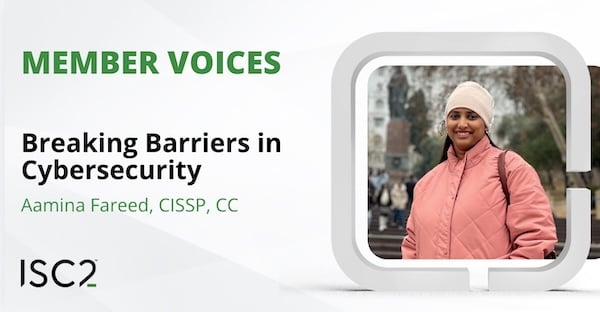
Cybersecurity demands resilience, intellectual curiosity, continuous learning and the courage to adapt in an ever-evolving digital landscape. For many women, building a career in this field also means confronting societal expectations, unconscious bias and long-standing stereotypes. But when competence meets courage and consistency, barriers begin to dissolve, argues Aamina Fareed, CISSP, CC.
 Disclaimer: The views and opinions expressed in this article belong solely to the author and do not necessarily reflect those of ISC2.
When we lift one another while pursuing excellence, we do more than build careers: we strengthen the very foundations of cybersecurity itself.
Despite hailing from a background where ambitious career paths for women weren’t always assumed, my fascination with technology began early. As a child, I would dismantle and reassemble our family computer, clean its internal components and troubleshoot performance issues simply out of curiosity. I was less interested in using technology and more interested in understanding how it worked.
As an adult, a defining moment occurred when a senior colleague introduced me to the Official Study Guide for the CISSP certification from ISC2. As I studied the material, I began to see cybersecurity not just as penetration testing or system hardening, but as a comprehensive framework encompassing risk management, compliance, architecture and leadership. The breadth of that perspective transformed how I approached the field. Cybersecurity became, for me, a strategic function that bridges business objectives with technical safeguards.
Leadership Requires a Broad Range of Skills
The technical knowledge necessary to implement safeguards is important – but cybersecurity leadership demands more; risk-based thinking, communication, resilience and strategic analysis are equally critical. My experience as a commissioned officer in the Indian Navy strengthened my leadership, sharpened my decision-making and trained me to perform under pressure. Those skills now translate into incident response planning, governance reviews and enterprise-level risk assessments. Cybersecurity requires calm judgment in moments of uncertainty, a quality cultivated through discipline and continuous self-improvement.
In my current role in a very large organization, I understand that cybersecurity is no longer confined to IT departments; it intersects with legal, compliance, operations and executive leadership. The ability to influence across functions determines whether security becomes reactive or strategic.
As a woman in cybersecurity, I’ve occasionally encountered implicit biases: moments when technical depth or leadership capability was questioned before my work was evaluated. In rooms dominated by strong, confident voices, finding and asserting one’s perspective can require deliberate effort. I simply worked harder, knowing that performance would ultimately be the most persuasive argument. Knowledge has consistently been my strongest equalizer. I invest heavily in continuous learning because competence speaks clearly.
Cybersecurity is Changing
The workplace is evolving and organizations increasingly recognize that diversity strengthens security outcomes. I’ve worked with inspiring colleagues and leaders who advocate for inclusion and merit-based growth. While some initiatives may begin as compliance-driven efforts, they often create genuine opportunities for women to demonstrate excellence, which reshapes perception. Conversations about inclusion are now happening at executive levels.
No meaningful career is built in isolation. Mentorship and professional communities play a powerful role in accelerating growth and expanding opportunity. When women actively support and uplift one another, they create a ripple effect that strengthens not only individual careers but the entire cybersecurity ecosystem.
Industry communities further amplify this growth. Conferences, certification bodies and global forums provide valuable platforms for learning, collaboration, and visibility. Events hosted by organizations such as ISC2 create inclusive spaces where professionals exchange insights, challenge ideas and elevate industry standards. Engaging in these communities builds not only technical expertise, but also confidence, connection and a shared sense of purpose.
For anyone aspiring to enter or grow within the field of cybersecurity, I offer the following:
- Find mentors and sponsors. Mentors provide guidance; sponsors create opportunities. Seek both.
- Build strong fundamentals. Develop a solid understanding of networks, operating systems, risk management and governance before specializing.
- Gain practical experience. Participate in capture-the-flag competitions, security labs, audits, or internal risk assessments to translate theory into practice.
- Pursue at least one foundational certification early. Structured study strengthens conceptual clarity and credibility.
- Learn to think strategically. Cybersecurity is not only about identifying vulnerabilities; it is about understanding impact, prioritizing risk and aligning security with business objectives.
For women, I add this: reject self-doubt. Imposter syndrome can surface in high-stakes environments. Your antidote is preparation, competence and courage. When competence meets courage and consistency, barriers begin to dissolve. When we lift one another while pursuing excellence, we do more than build careers; we strengthen the very foundations of cybersecurity itself. I see more women earning advanced certifications, leading security operations centers, shaping governance frameworks and influencing enterprise risk strategies.
Today, I serve as Manager, Technology Risk & Control, applying strategic risk thinking to protect complex digital ecosystems. Women are not peripheral contributors; we’re architects of stronger, more resilient digital ecosystems.
Aamina Fareed, CISSP, CC has 14 years of experience in governance, risk management and compliance. She has held technical and leadership roles, with responsibility towards enterprise risk strategy, compliance, governance and security oversight. Her cybersecurity work spans risk management, stakeholder management and data security.
Global 50x50 Women’s SummitTaking place on March 18, 2026, the Global 50x50 Women’s Summit is a virtual event which will bring together women and allies from every corner of the cybersecurity ecosystem to explore how inclusive leadership, intentional sponsorship, and meaningful mentorship open doors to opportunity and reshape the talent pipeline. Supported by ISC2 and The Centre for Cyber Safety and Education, this event builds on the work of the Global 50x50 Initiative towards a future where women make up 50% of the cyber workforce by 2050. The Summit will highlight the actions needed to create a more resilient and sustainable cybersecurity workforce for all. By attending this live event, you are eligible to receive 3.5 CPE credits. Additional credits can also be earned with on-demand viewing. |
.png?h=420&iar=0&w=420)