The Global 50x50 Women’s Summit explored expanding opportunities for women and creating space for varied talents to shape smarter, stronger and more resilient cybersecurity teams.
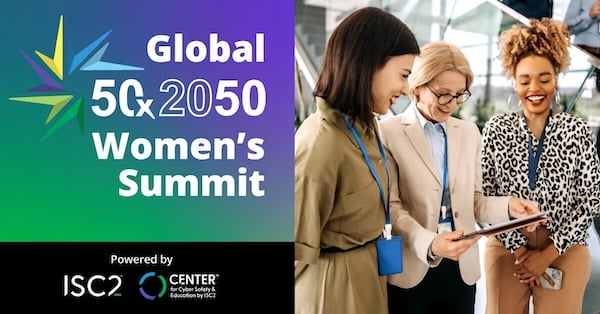 Have you ever wondered whether there’s a place for you in cybersecurity if you’re not a coder, pentester or simply not technical, as was the case, for instance, with Alexis Sands, CC, a Senior Security Analyst at ISC2? Rafah Knight, CEO and Founder of SecureAI, a recognized leader in AI security and risk management, kicked off the recent Global 50x50 Women's Summit powered by ISC2 and the Center for Cyber Safety and Education, asking this very question of the women and allies who attended the virtual event.
Once focused on art during her university studies, Knight ultimately found her way to cybersecurity and risk management, currently specializing in AI security. During her Beyond the Algorithm: Women, AI Security, and Building What Matters keynote, Knight delivered a motivating message – there has never been a better, more exciting, more wide‑open moment for women to shape the future of cybersecurity. As Knight emphasized: “You can put in place as many controls as you like, but human behavior is so important and, actually, that ability to understand the human mind is so important in a field of cybersecurity.”
It’s no wonder that Knight recently was recognized with the Most Inspiring Women in Cyber award!
Cybersecurity Isn’t Just a Technical Field; It’s a Human One
Knight’s own early work in governance, risk and compliance (GRC) validated that you don’t need to be a programmer to thrive in cybersecurity. In fact, some of the most critical roles, particularly in AI security, require skills rooted in communication, psychology, culture, critical thinking and human behavior.
Both cybersecurity hiring managers and professional participants in the 2025 ISC2 Cybersecurity Workforce Study agreed. They identified problem-solving, teamwork/collaboration and communication skills as the top three skills needed. Cybersecurity professionals who participated in the study viewed strong communication skills as the top in-demand skill (59%), whereas hiring managers ranked it third (48%) on their list of skills they are prioritizing when hiring. As Knight explained, “You can build a brilliant system of controls, but if you don’t understand people—how they think, why they take risks, how they behave under pressure—you haven’t secured anything at all.”
Opportunity for Women in Cybersecurity
Knight did raise the issue that, as exciting as the cybersecurity profession is, it hasn’t always been a welcoming space for women. However, that landscape is changing, especially because leaders like Knight are advocating for deeper, systemic shifts. As the latest ISC2 women in cybersecurity research revealed, 72% of female respondents noted that cybersecurity is a welcoming career path for women. Still, there is room for improvement to attract and retain women in cybersecurity.
Knight highlighted three major areas where the industry must do better:
Fund Women Founders
Knight pointed out that, globally, only 2–3% of venture funding goes to women-led companies. In 2024, 2.3% of global venture capital went to female-only founding teams. In cybersecurity, an industry historically dominated by men, that gap is even more glaring.
Empowering women means putting real capital behind them. It means investing in their ideas, amplifying their expertise, and helping them take their place as founders, innovators, and industry leaders.
Champion Visibility and Widen Networks
Cybersecurity can still feel like a male-dominated profession. Knight suggested that one of the most powerful things comes in the form of male allyship, noting that, “Supporting women is incredibly powerful. In my career, I've been supported by men a tremendous amount and it has made a world of difference.” She added, "Actually supporting women, regardless of what grade or seniority, is such an incredible thing.”
What can allies and other women do to champion visibility and widen networks? Make introductions. Invite women into rooms they may not have access to. Advocate for them when they’re not present.
Knight pointed out that sometimes the difference between being overlooked and being elevated is a single ally saying, “She’s the expert. Please direct your questions to her.”
Retain Women by Making Work Work
Flexible work. Remote options. Pathways to leadership that don’t require compromising family life. These are requirements for retaining talented women who might otherwise leave the profession entirely. The ISC2 women in cybersecurity research aligns with these statements, with 42% of women participants citing that support for caregivers or flexible work arrangements would make the most difference to their success in the cybersecurity workforce.
The data is clear, according to Knight. In the U.K., women still shoulder 70% of household labor, even when they are working full-time. In cybersecurity, Knight expressed that losing women mid‑career is not just a staffing issue; it’s a strategic failure. It’s crucial for the retention of women, therefore, to build inclusive and accessible teams and working environments, and normalize flexible schedules and hybrid/remote roles.
Creating Room at the Table
If women are entering the field in growing numbers at junior levels but disappearing at senior ones, something is broken. Making room at the proverbial table means:
- Inviting women into boardrooms
- Offering leadership pathways designed for inclusivity
- Ensuring diverse voices shape not just policies but the future of the industry
- Recognizing that cybersecurity is stronger when leadership looks like the world it protects
Cybersecurity doesn’t need a monolith of technical minds. It needs a mosaic of human ones. If cybersecurity is going to evolve, then women must be present at every level. As Knight asked: “What do we want to see in cybersecurity? Different minds and different people coming together, focusing on providing real solutions to growing problems.” She elaborated, “You can put in place as many controls as you want, but if you don't start with people, if you don't focus on the culture and if you don't focus on helping people understand and think critically about security, then you've got a lot of work to do. You're opening yourself up to a whole lot of risk.”
The future of cybersecurity must be shaped by the collective and inclusive strength of many perspectives. Progress depends on creating a field where different minds, diverse experiences, and varied talents come together to confront complex challenges with fresh insight and human‑centered solutions. When the profession invites more voices to the table, including those of women, organizations can build a safer and more secure world.