
Economic Challenges Impacting Confidence and Career Choices | Perceptions of Representation | Challenges to Women’s Retention and Advancement in Cybersecurity | Women in Leadership | AI and Skills Needs Impacting Women in Cybersecurity | Job Satisfaction | Responding to the Needs and Feedback of Women in Cybersecurity
In recognition of International Women’s Day and International Women’s Month, ISC2 examines the views and experiences of women working in cybersecurity roles, based on responses to the latest ISC2 Cybersecurity Workforce Study.
Although demand for cybersecurity skills remains high, layoffs, advancement freezes and longer recruitment cycles are among several factors impacting teams where the imbalance between men and women stays elevated. In times of restructuring or cost-cutting, women can face heightened job insecurity, impacting both job satisfaction as well as reducing opportunities to enter and advance in the cybersecurity field. These challenges can also create obstacles for developing the much-needed skills that current and future cybersecurity roles require.
Every year, the ISC2 Cybersecurity Workforce Study assesses the state of the cybersecurity workforce. Alongside the overall findings, we look at several key indicators by gender, to spotlight the views and contributions of women working in cybersecurity, who remain underrepresented globally. Out of the 16,029 participants in the study, 2,603 were women.
Economic Challenges Impacting Confidence and Career Choices
Pay freezes, budget cuts and layoffs continued to put pressure on the cybersecurity community over the past year. Women participants were more likely than men to report that their organizations experienced security layoffs in the past 12 months (28% vs 23%). While confidence in cybersecurity as a career remains high among all participants, women expressed marginally lower confidence in the long-term strength of the cybersecurity profession, with 78% reporting optimism compared with 83% of men who participated. Similar disparities in the view of women and men arose in perceptions of future demand: While still high for all, 88% of men believe there will always be a need for cybersecurity professionals, only 82% of women share this view.
These economic concerns may be reflected in women’s broader career outlook, with women participants also more likely than men to have considered switching careers due to current market conditions (33% vs 27%).
Perceptions of Representation
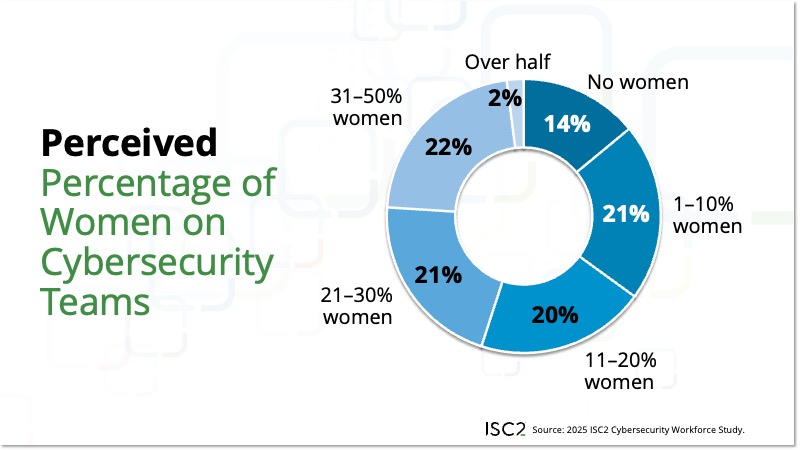
We asked all participants to estimate the percentage of women cybersecurity professionals working in their organization's security teams, with noticeable variations across both regions and industrial sectors. These estimates reflect individual perceptions and are not representative of global gender distribution in cybersecurity. However, these figures provide meaningful insight into how representation is perceived within cybersecurity.
Just over a fifth (21%) of participants perceive their cybersecurity teams as having only 10% women or fewer. Furthermore, 14% reported that their cybersecurity teams contain no women at all. However, 22% said their cybersecurity teams have between 31-50% women, with a further 2% having gender parity, or are majority women.
When examining the average percentage of women on security teams globally, participants in India reported the highest percentage of women (23%), followed by Canada (21%), the United States and China (both 18%). Germany and the Netherlands saw the smallest perceived percentage with 15%, lower than Japan (16%) and the UK (17%). Many of these figures remain relatively unchanged from our 2024 data, highlighting that amid the downward pressure on jobs and advancement opportunities, there has been little perceived change in the representation of women working in cybersecurity teams in the last two years. It also echoes the overall study finding that while the economic and jobs situation has not improved, it has not worsened either, instead showing signs of stabilization.
By industry, both security software/hardware development and retail/wholesale reported the highest average percentage of women on their security teams at 24%. Consulting, food/beverage/hospitality/travel, automotive and construction industries followed at 23%, while aerospace, engineering, hosted/cloud and IT services saw an average of 22% of women within cybersecurity teams.
Challenges to Women’s Retention and Advancement in Cybersecurity
Uncertainty about career stability and long-term opportunities, as well as factors that are not necessarily economically driven, including organizational barriers to advancement, are seen by women participants as contributing factors to lower levels of women in the profession.
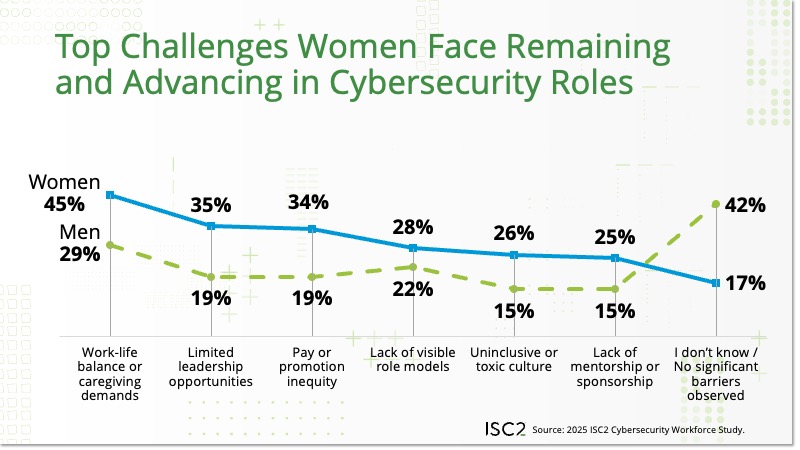
The participant data reveals notable differences between women's and men's perspectives on the barriers hindering women from staying and advancing in the field. For example, areas like work-life balance and pay inequity in particular highlight gender disparity. Nearly half of women participants (45%) considered work-life balance and caregiving demands to be the top challenge faced by women in cybersecurity, compared to 29% of men participants. When asked if pay or promotion inequity has prevented women from moving forward, a third (34%) of women participants said it had, as opposed to just 19% of men.
What’s more, 42% of men participants reported that they were unaware of any significant barriers for women—a figure 2.5 times higher than what was reported by women participants (17%).
Nevertheless, despite the gender disparity in the cybersecurity profession and obstacles to advancement, three-quarters (75%) of all participants describe cybersecurity as a welcoming career path for women in their country or region. Perceptions differ slightly by gender, with 77% of male participants agreeing that cybersecurity is a welcoming career path for women, while 72% of women participants share this view.
Women in Leadership
The majority of all study participants (83%) reported seeing women represented in either leadership and/or technical roles within their organizations. Specifically, 60% reported seeing women in both roles, 12% reported only seeing women in leadership roles, and 11% reported only seeing women in technical roles.
However, perceptions of how many women are in both leadership roles and technical roles change depending on the career level of the participant.
For example, women participants in C-suite and executive leadership roles are significantly more likely than men to report seeing women in both leadership and technical roles within their organization (71% vs 57%). Similar awareness variances appear at director and manager levels.
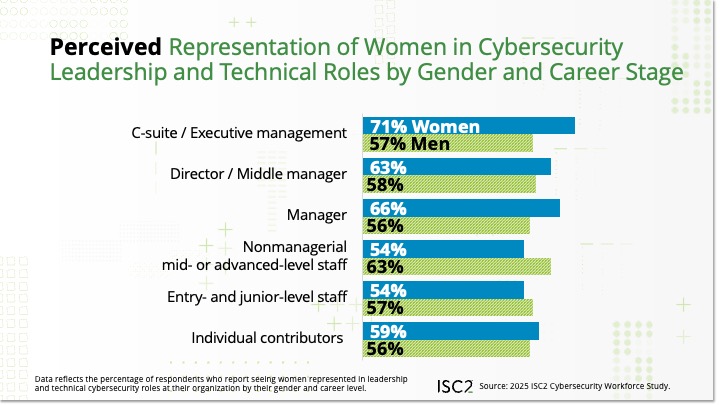
In non-managerial mid/advanced level staff, the results switch and more men participants than women report seeing women represented in cybersecurity (63% men vs 54% women). Furthermore, nearly a quarter (24%) of women participants in entry- and junior-level roles cited rarely or never seeing women in leadership or technical positions, compared to just 15% of men.
AI and Skills Needs Impacting Women in Cybersecurity
The need for specific skills within cybersecurity is a major consideration for hiring managers, impacting the number and type of roles available and the opportunity for career entry and advancement. Artificial intelligence (AI) was the most pressing skills need cited by respondents (41%) in the study, as well as being the second-highest technical skill valued by hiring managers (27%). Over a quarter (28%) of all participants noted their organizations have already integrated AI tools into their operations, with a further 19% actively testing them and another 22% in the early evaluation phase, accelerating the need for AI skills.
Interestingly, women participants (27%) are more likely than men (17%) to report having “significant” knowledge of AI and machine learning.
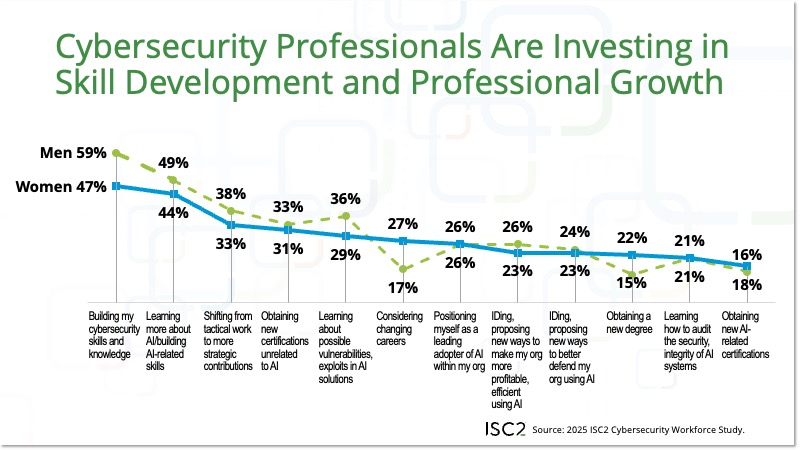
To prepare for an AI-driven future, both women and men in cybersecurity are investing in skill development and professional growth—sometimes in different ways. Building cybersecurity and AI-related skills is the most common strategy for both groups.
However, when looking at how likely women participants are to remain in their cybersecurity role, the growth of AI and the demand for AI-relevant skills are significant factors shaping their decisions. Some 27% of women participants have considered changing their careers to prepare for an AI driven future, compared to just 17% of men.
Job Satisfaction
Despite the challenges to entry and advancement that women participants have highlighted, job satisfaction has rebounded for women participants in 2025 following three consecutive years of decline. Over the past year, average job satisfaction among women participants has increased from 67% to 71%.
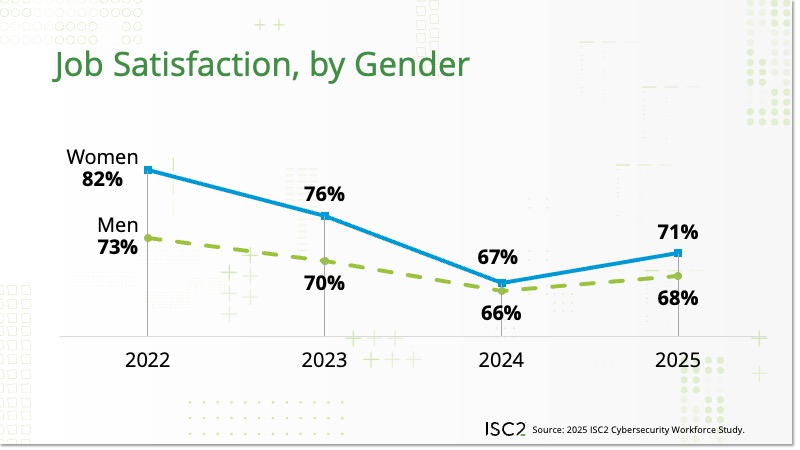
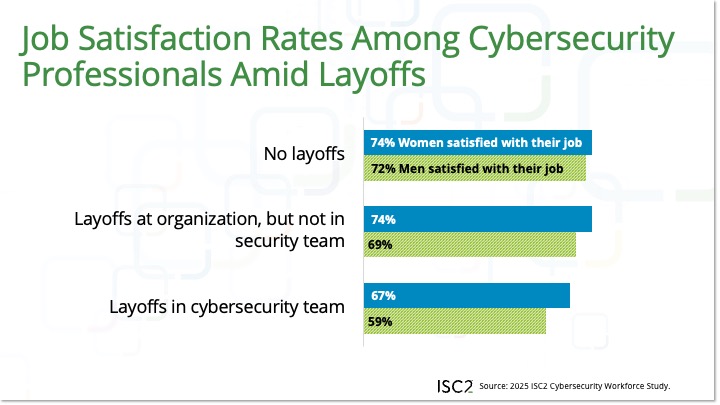
Job satisfaction in cybersecurity continues to be directly impacted by economic-driven factors such as layoffs. For both men and women participants, proximity to security layoffs within their organization is associated with lower satisfaction levels. Women who reported no layoffs at their organization, or only layoffs outside of the cybersecurity team, reported an overall satisfaction score of 74%. Yet when layoffs occurred within the cybersecurity team, their overall satisfaction dropped to 67%.
That said, for women who reported cybersecurity cutbacks at their organization, current job satisfaction was slightly higher at 67%, compared to 64% in 2024.
Across other job-related factors, women participants report lower satisfaction than men with their direct supervisor (71% vs 74%) and with their team (74% vs 78%).
Responding to the Needs and Feedback of Women in Cybersecurity
For women working in cybersecurity, or considering it as a career path, consider the following:
- Build strong technical and non-technical skills: Cybersecurity is a broad, and fast-moving sector. Continuous education is key. While organizations need to invest in training and education as part of a wider focus on investing in people, proactive learning and development is key.
- Don’t view AI in isolation: AI is now a fundamental consideration across all aspects of cybersecurity, rather than a standalone skill. Certifications and courses to supplement knowledge and develop these skills set you out in a crowded market. Employers also value proof of skills. Practical experience — even self-driven — is powerful.
- Leverage your community and mentorship opportunities: As participants have highlighted, cybersecurity can feel isolating, so support and representation matters. Access to assigned or structured formal mentorship was noted by 40% of women participants, and sponsorship from leadership by 32%. Many senior women in cybersecurity are eager to mentor — but you need to reach out first.
- Plug into communities that support women in the field: Nearly half (45%) of the women participants reported having access to informal mentorship or peer networks. As well as your local and global ISC2 member and chapter communities, also look at groups such as Women in CyberSecurity (WiCyS) and the Women’s Society of Cyberjutsu.
The study responses also highlight opportunities for organizations to create a more accessible, appealing and viable career opportunities for women, without compromising the value of the role or the contribution that women make to cybersecurity teams:
- Make advancement transparent and sponsor leadership: Representation at leadership levels signals long-term viability, rather than just being an entry-level opportunity. Assign executive sponsors who actively advocate for women’s advancement, align cybersecurity leadership training to certifications like the CISSP for consistency, enable better visibility for women working in cybersecurity by supporting speaking and writing opportunities.
- Maintain a developmental ethos for all: Develop mentorship programs that connect women leaders and/or technical experts to entry/junior-level team members to help support their professional development, provide guidance and share experience.
- Build inclusive and accessible teams and working environments: Retention of people, knowledge and skills is essential. Normalize flexible schedules and hybrid/remote roles. 42% of women participants cited that support for caregivers or flexible work arrangements would make the most difference to their success.
- Support change: Work with and support efforts like the Global 50x50 Initiative, a grassroots movement to deliver a future where women make up 50% of the cyber workforce by 2050. Initiatives like this elevate women’s voices, innovation and leadership in cybersecurity and highlight the actions needed to create a more resilient and sustainable cyber workforce for all.
Adding support in these areas may very well boost organizations’ ability to retain women working in cybersecurity teams along with their valuable knowledge and experience.
Economic Challenges Impacting Confidence and Career Choices | Perceptions of Representation | Challenges to Women’s Retention and Advancement in Cybersecurity | Women in Leadership | AI and Skills Needs Impacting Women in Cybersecurity | Job Satisfaction | Responding to the Needs and Feedback of Women in Cybersecurity
Global 50x50 Women’s SummitTaking place on March 18, 2026, the Global 50x50 Women’s Summit is a virtual event which will bring together women and allies from every corner of the cybersecurity ecosystem to explore how inclusive leadership, intentional sponsorship, and meaningful mentorship open doors to opportunity and reshape the talent pipeline. Supported by ISC2 and The Centre for Cyber Safety and Education, this event builds on the work of the Global 50x50 Initiative towards a future where women make up 50% of the cyber workforce by 2050. The Summit will highlight the actions needed to create a more resilient and sustainable cybersecurity workforce for all. By attending this live event, you are eligible to receive 3.5 CPE credits. Additional credits can also be earned with on-demand viewing. |