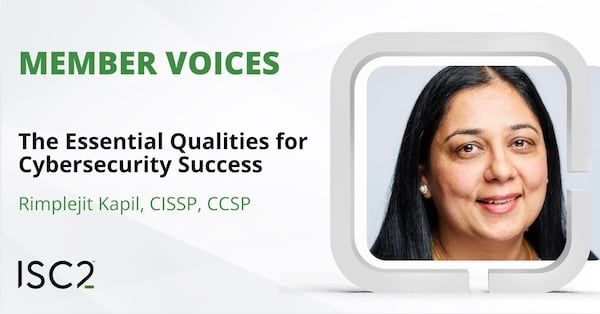
The cybersecurity career of Rimplejit Kapil, CISSP, CCSP, has been shaped by curiosity, persistence, setbacks, support systems and a deep belief that meaningful growth rarely comes from shortcuts. As a Senior Cybersecurity Architect, a woman and with over two decades of experience in this industry, she looks back at my journey not just with pride, but with perspective and with optimism for the future of women in cybersecurity.
 Disclaimer: The views and opinions expressed in this article belong solely to the author and do not necessarily reflect those of ISC2.
My journey into cybersecurity was not linear, not easy and certainly not planned. In fact, began my career as a network engineer. At that time, my focus was purely technical: routing, switching, connectivity and performance; security wasn’t the primary concern it is today and was often an afterthought. However, as I got deeper into networking, I began to see how fragile systems could be when security was not designed in from the beginning.
That curiosity gradually pulled me into network security, then cloud security and eventually into security architecture. It was a long journey and – I’ll be honest – it was not simple. There were moments of self-doubt, steep learning curves and times when the path forward felt unclear. But with the support of the right people, consistent hard work and a willingness to keep learning, I found my way.
Taking Responsibility For Your Own Path
I strongly believe in the idea that if you want to do something right, you should avoid shortcuts. In today’s era of AI and automation, we often hear the phrase “work smarter, not harder”. While I understand the intent behind the proverb, I still value the ‘hard way’ of learning. I’ve built resilience by struggling through complex problems, spending time exploring systems deeply and making mistakes along the way. It has given me context, judgment and confidence; qualities that are essential for long-term success in cybersecurity. There’s constant evolution, too; cybersecurity never stands still. Threats change, architectures change and expectations change. That continuous movement keeps me alert, humble and engaged. There’s always more to learn and that is energizing.
But cybersecurity is far from being only about hacking or technical controls; there are many different fields and flavors. While technical expertise is critical, some of the most important skills in cybersecurity professionals are non-technical: having an open mindset, the patience to listen and the ability to understand perspectives beyond security. I learned to engage with system owners, application teams, business stakeholders and engineers, each with their different priorities and constraints.
Good security does not exist in isolation, but must balance risk, usability, performance and business outcomes. From me, that requires empathy, communication and the ability to think holistically. In many cases, the challenge is not identifying a security risk but explaining it clearly and working collaboratively toward a practical solution. This is an area where women often bring immense value, yet it is sometimes overlooked. Cybersecurity is not just about defending systems, it’s about enabling trust.
Positive Changes to the Culture
During my years in the cybersecurity sector, I’ve seen positive changes in inclusion and workplace culture. At an organizational level, there is greater awareness and support than there was earlier in my career. Conversations around inclusion, flexibility, mentorship and psychological safety are becoming more common and more meaningful. As a result, organizations increasingly recognize the importance of diversity in security teams and more women are stepping into challenging technical and leadership roles.
That said, progress is uneven. Some environments are further along than others and real inclusion goes beyond numbers. It is about whether women feel heard, supported and trusted in decision-making roles. While there is still work to be done, the direction of travel gives me confidence.
Support Makes a Difference
Support has played a crucial role at every stage of my career, but it’s important to acknowledge that the type of support I needed has changed as my life has evolved.
Family support has been fundamental. Progression in cybersecurity often requires ongoing study, certifications, upskilling and staying current while managing a full-time role. That balance would have been challenging without understanding and encouragement from my family.
Equally important has been the professional support I’ve enjoyed. Having mentors, especially women mentors, has been a blessing. A mentor who understands not only the technical challenges, but also the everyday realities of balancing work, learning and personal responsibilities, can make a significant difference. Sometimes, that support has come in the form of guidance; sometimes it has simply been someone giving me the time and space to grow. Persistence combined with consistent support turns challenges into manageable phases rather than permanent roadblocks.
Cybersecurity Is About Constant Improvement
Technical skills are, of course, essential in cybersecurity and continuous learning has been non-negotiable. While my background spans network security, cloud security, identity and access management and secure-by-design practices, some of the most important skills for my success have been non-technical: communication, critical thinking, patience and listening, and confidence with humility.
I’ve been fortunate to work in environments where my organization supported the development of such skills through opportunities, exposure to complex designs and trust in my judgment. That trust is powerful; it allowed me to grow into my role rather than constantly proving I belong.
I don’t want to pretend otherwise: cybersecurity has, historically, been a field in which women are underrepresented. Yes, there have been times when I felt I had to work harder to be taken seriously. But I also believe many women experience impostor syndrome and that we often feel the need to master a subject completely before speaking up. Over time, I learned that I don’t need to have all the answers to participate meaningfully. Sometimes, a thoughtful question or an early perspective adds immense value.
Barriers to my own progression have largely been reflections of phases in my life and shifting priorities. Marriage, children and caregiving responsibilities redefined what balance looked like to me. When I stepped into an architect role in the middle of my career, I also became a new mother and took two years away to focus on my newborn. When I returned, technology had changed and I found myself stepping back into a network engineer role.
That was not easy. It required humility, resilience and a commitment to re-skill myself. But that phase did not erase my experience, it reshaped it. Over time, through upskilling and persistence, I moved forward again. Our careers are not straight lines; they are shaped by seasons and stepping back does not mean stepping down permanently.
The Factors That Make a Difference
The biggest differences to career paths come from flexibility, mentorship and trust. Flexible career paths acknowledge the reality of life stages, allowing women to stay connected to the industry even when they need to slow down or even absent themselves temporarily. From experience, I know that strong mentorship, especially from women who have navigated similar journeys, helps build confidence and clarity. Additionally, trust from organizations empowers women to grow into leadership roles without constant justification.
If you are thinking about joining the world of cybersecurity, my advice is simple but deeply important:
- Don’t be afraid to start where you are
- Don’t wait until you feel “ready” to speak up
- Invest in fundamentals; understanding systems deeply will always pay off
- Seek mentors and build a support network
- Be patient with yourself during different phases of life
Cybersecurity is changing – not just in numbers but in mindset, becoming more human-centric. I see organizations valuing secure-by-design thinking, collaboration and leadership beyond pure technical knowledge – women’s strengths – and it’s why I see more women stepping into architecture, strategy and decision-making roles. Cybersecurity needs diverse perspectives – which means neither you nor your journey into cybersecurity need to look like anyone else’s to be valid.
Rimple Kapil, CISSP, CCSP, has 21 years of experience in telecommunications, cloud platforms, network infrastructure, and cybersecurity architecture. She has held technical and architecture roles, with responsibility for designing, reviewing, and assuring secure solutions across cloud and on-prem environments. Her cybersecurity work spans network security, cloud security, risk management, and secure-by-design practices.