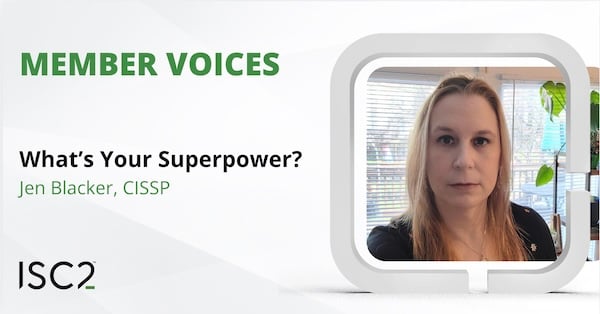
For Jen Blacker, CISSP, the transition from librarian to cybersecurity professional showed her that her non-traditional background is her superpower. Research skills help track down solutions to security problems. The ability to translate complex information for library users is how she creates security awareness content that resonates.
 Disclaimer: The views and opinions expressed in this article belong solely to the author and do not necessarily reflect those of ISC2.
I believe the best cybersecurity defense starts with people, not technology alone. So, as a human risk management and security awareness champion, my goal is simple: teach people to protect themselves, their clients and their families by breaking down complex cybersecurity concepts into language they can understand and use. To achieve this goal, I create cybersecurity awareness content that emphasizes empowerment over fear and write engaging communications that help people understand how to protect themselves, their clients and our organization.
An Unexpected Journey
My journey into cybersecurity started in an unexpected place: the library. I spent years as a corporate librarian. That might seem worlds away from cybersecurity, yet the skills I developed there became the foundation for everything I do now. Researching, finding answers, solving complex problems. These skills transfer beautifully.
I've always been a gamer girl. From arcade games to consoles to PC, gaming has been part of my life since the beginning. I currently love playing city builders and base builders because they let me think creatively about systems and defenses. These skills also translate surprisingly well to cybersecurity.
In 2021, I made the pivot away from the library. I was blessed with an incredible mentor who later became a close friend. In just our first conversation, he mapped out what I should start learning and then did something brilliant: he had me sit in meetings where I didn't understand a word of what was happening. "Just absorb it," he told me. I did, eventually. The meetings became less mysterious; the jargon became familiar. Suddenly, I was contributing to conversations I once just observed. The experience taught me the power of patience and persistence. It's why I'm so passionate about mentoring others now.
Non-Traditional Paths Forge Superpowers
That transition from librarian to cybersecurity professional taught me that my "non-traditional" background is my superpower. My research skills map to track down solutions to security problems. My ability to translate complex information for library patrons enable me to create effective cybersecurity awareness content.
Cybersecurity needs communicators just as much as it needs technical experts. Writing engaging communications is my favorite part of the job. I love the creative challenge of taking complex security concepts and turning them into content that people want to read and can actually use. Whether it's explaining phishing tactics, password security, or multi-factor authentication, my goal is always the same: make it clear, make it useful, make it empowering.
I'm absolutely a blue team person. I love defending and protecting. I also have deep respect for how cybercriminals constantly evolve their tactics. It's a chess match and that challenge is what keeps me engaged. The field is always changing. There's always something new to learn. For someone who came from a world of constant research and learning, that's perfect.
Learning From the Experience
What I've discovered is that confidence doesn't mean knowing everything. It means being confident enough to say, "I don't know this yet, but I'll figure it out.” Now I'm in a position to lead and mentor others and I try to give them the same patient guidance my mentor gave me.
If you're considering a career in cybersecurity, especially if you're coming from a non-traditional background, here's what I'd tell you.
Find your mentor, because the right mentor can change everything. Mine saw potential in me before I fully saw it in myself. He didn't just tell me what to learn, but showed me how to learn by doing, even when I felt completely lost. That relationship became one of the most valuable parts of my career journey.
Understand that your "different" background is an advantage. Whatever you did before gave you skills the cybersecurity field needs. Librarian, teacher, project manager, analyst? These roles teach research, communication, organization and problem-solving. Don't apologize for your path; leverage it.
The Value of Certifications and More
Start with certification but don't stop there. Each certification I’ve earned has opened new doors and deepened my understanding. I’d say: pick certifications that align with where you want to go, whether that's technical, management, or awareness.
Get comfortable with being uncomfortable. Remember those meetings I mentioned at which I understood nothing? My discomfort was growth, happening. Sit in on calls, join working groups and volunteer for projects slightly beyond your current skill level. You'll be amazed at how quickly you’ll start to understand.
Focus on communication. Cybersecurity desperately needs people who can explain things clearly. If you can write, teach, or present complex ideas in accessible ways, you have a skill that will set you apart. Technical knowledge can be learned; the ability to communicate clearly is harder to find.
Play to your strengths. I'm not trying to become a penetration tester and that's okay; I found my place in awareness, communication and helping people understand security in ways that stick. The field is vast enough for everyone to find their niche, so figure out what energizes you and build expertise there. If making complex things simple lights you up, awareness and training need you.
Remember why you're doing this. I got into cybersecurity because I wanted to help people protect what matters to them. Whether you're teaching employees to spot phishing, creating awareness content that is actually read or developing training programs that change behavior, you're making the digital world safer. Every newsletter that helps someone avoid a scam, every presentation that makes security click for non-technical folks and every piece of content that empowers instead of scares has real impact. Knowing your purpose will carry you through the challenging days.
Cybersecurity isn't just for people who've been coding since they were twelve or who have computer science degrees. It's for anyone willing to learn, adapt and contribute to making our digital world more secure. Your unique background brings a perspective this field needs.
Yes, we need more women. We need more diverse voices and more people who can bridge the gap between technology and the humans who use it. The door is open, ladies (and gentlemen). Walk through it.
Jennifer Blacker, CISSP, has six years of experience in international engineering and consulting firm cybersecurity operations and compliance. She has held business and management roles, with responsibility for security awareness programs, CMMC compliance and vendor risk communications. Her cybersecurity work spans phishing simulations, policy development, and global employee training campaigns.