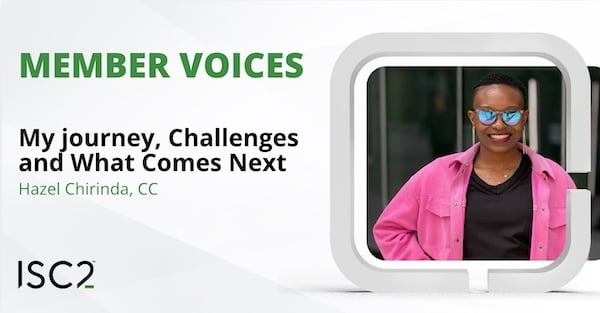
What excites Hazel Chirinda, CC, in cybersecurity today is momentum. Women today are not just entering the field, but leading teams, driving strategy, mentoring others and shaping the future of security. For her, there’s a growing sense of community, shared purpose and mutual support that didn’t exist a decade ago.
 Disclaimer: The views and opinions expressed in this article belong solely to the author and do not necessarily reflect those of ISC2.
I was drawn to cybersecurity by curiosity: the desire to understand how systems fail and how we can protect organizations and people from harm. But over the years, what’s kept me here is something different: impact. My purpose lies in knowing that the work I do helps people sleep better at night, empowers teams to make confident decisions and strengthens organizations in the face of evolving threats. Cybersecurity is a dynamic, human problem and that’s where I find the heart of this profession.
My technical skills built my foundation. However, it’s my non-technical skills that have profoundly shaped my personal trajectory:
- Communication: Explaining risk in business terms
- Strategic Thinking: Connecting security to outcomes
- Confidence: Owning my perspective in technical and executive conversations
- Adaptability: Learning new technologies and frameworks as threats evolve
These are attributes that help bridge the gap between cybersecurity and business value — and they’re often what separates good practitioners from impactful leaders. I think it’s important that anyone considering a career in cybersecurity recognizes that these attributes are sought-after. Technical skills can be taught and learned.
A Hand Up
Support isn’t just about training; it’s about exposure and trust. It’s certainly the support that has mattered most to me. Early in my career, having leaders who gave me responsibility – even when I didn’t feel “ready” – built confidence and competence. Being put into situations where I had to communicate with business stakeholders, defend security strategies and make decisions in ambiguous circumstances accelerated my growth.
One of the most frustrating elements has been the persistent subtle bias that technical credibility must be proven repeatedly, especially in client-facing or leadership conversations. I’ve walked into rooms where my expertise was immediately assumed, but into other rooms in which I had to demonstrate my expertise clearly before it was recognized. There were moments, especially earlier in my journey, when I felt the need to over-prepare to make sure my expertise was unquestioned. Over time, I learned that being prepared is different from needing to prove yourself more than others and that confidence and clarity of communication are as vital as technical knowledge. Understanding that shift — from proving worth to owning presence — was transformational.
My experiences have highlighted a broader misunderstanding: that women in cybersecurity must choose between being technical and communicative. In reality, those skills are complementary, not competing, and they are essential for effective security leadership.
That all said, I’ve certainly seen meaningful progress: more women are entering the field and there’s more visibility and conversation around inclusion. What’s different now is not just representation, but intentional support structures: mentoring programs, supportive networks and leaders who advocate for diverse voices.
Inclusion Is Needed to Empower Women in Cybersecurity
I still believe that inclusion must go beyond numbers; unspoken barriers exist at many levels. One of the most persistent is visibility; that is, not just being present in the room, but being positioned as the expert whose voice shapes decisions. Women often get credit for being supportive team members, but not always for steering strategy or thought leadership.
There’s also the invisible weight of emotional labor: mentoring others, smoothing stakeholder concerns and translating technical for non-technical audiences. This isn’t always recognized or rewarded, either. Inclusion should mean creating environments where women routinely lead, influence strategy and be recognized for their contributions, not just fill roles.
Three things that I’ve identified which would accelerate momentum for women in cybersecurity:
- Intentional Sponsorship: Leaders advocating for women’s advancement
- Early Leadership Exposure: Opportunities to influence strategy, not just execute tasks
- Recognition of Diverse Strengths: Valuing communication, strategy and leadership equally with technical expertise
- Broad Perspectives: When organizations broaden what leadership looks like, they unlock potential that’s already there but is often underutilized
What Excites Me Today is Momentum
Women today are not just entering the field, we’re leading teams, driving strategy, mentoring others and shaping the future of security. There’s a growing sense of community, shared purpose and mutual support that didn’t exist a decade ago.
So, if you’re considering cybersecurity, bring your authentic self to this community. Your perspective is valuable and the field needs diverse approaches to solving complex problems. Don’t wait to be “perfectly ready” before stepping into opportunities. Do invest yourself in learning continuously, communicating confidently and building networks that challenge and support you.
Cybersecurity isn’t just about defending systems; it’s about making systems work for people. It requires diverse voices — including yours.
Hazel Chirinda, CC, has over five years of experience in cybersecurity, IT consulting, Enterprise IT/SMB IT services and the Microsoft 365 ecosystem. She has held technical and consulting roles, with responsibility for deploying security solutions and optimizing client IT systems. Her cybersecurity work spans endpoint protection, cloud security, compliance and security awareness initiatives.