Who Will Benefit
Designed for cybersecurity practitioners and security leaders who operate, assess, secure or govern AI-enabled security environments. Learners should have foundational familiarity with areas such as cybersecurity threats and controls, incident response, security operations, networking and AI system architectures.
Relevant roles include:
- Penetration testers and red team operators
- SOC and security operations professionals
- Incident responders
- Threat detection and threat analysis professionals
- Network security professionals
- Security engineers
- Security architects
- Vulnerability management analysts
- Security managers
- Cybersecurity program managers
- Infrastructure professionals responsible for AI-enabled environments
Key Topics
- AI-augmented penetration testing capabilities and limitations
- False positives, AI hallucinations and finding verification
- Hybrid PTaaS orchestration and agent access models
- Continuous offensive validation and governance controls
- Program maturity, implementation planning and risk communication
- AI-augmented incident response
- AI-assisted threat detection and behavioral analytics
- AI traffic and network flow analysis
- AI multi-agent security
Learning Outcomes
- Learn to distinguish where AI can automate or augment security work from activities where human judgment, validation and leadership remain essential.
- Build familiarity with how AI affects penetration testing, incident response, threat detection, behavioral analytics, network monitoring and distributed multi-agent environments.
- Develop an approach to AI-enabled security that emphasizes verification, accountability, governance and appropriate human intervention rather than automation for automation's sake.
- Explore how security teams can use AI as a capability while also learning to secure systems and environments increasingly dependent on AI.
- Interactive branching scenarios require learners to apply cybersecurity knowledge to realistic situations, evaluate alternatives and make operational decisions.
- The certificate connects disciplines traditionally treated separately, helping learners understand how AI affects security operations across the organization.
Benefits
- Apply AI where it adds meaningful security value
- Prepare for AI-enabled security operations
- Strengthen human oversight
- Address both sides of AI security
- Practice decision-making, not just recall
- Build a broader AI security perspective
- Earn CPE credits
Program Completion
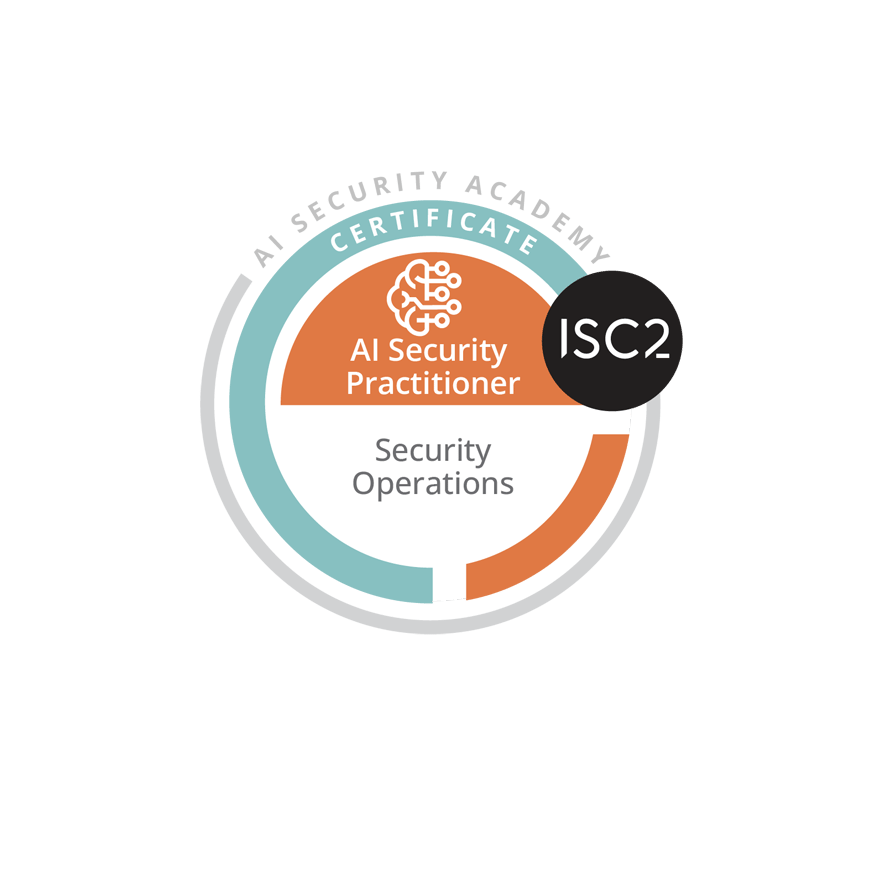
Learners have 60 days from the date of purchase to complete the courses. Learners who complete all five courses, once all are available, will earn the AI Security Practitioner: Security Operations Certificate Credly digital badge to showcase their skills on social media. Learners also receive a Validation of Completion for each course and earn continuing professional education (CPE) credits. We recommend that you download and retain the Validations of Completion for your personal records.
To receive a Validation of Completion and earn CPE credits for each Course, learners must:
- Complete the learning experience
- Pass the assessment
- Complete the learning experience evaluation
Credit Info
| CPE Credits |
Group A |
11 |
| Field of Study |
Security Operations |
|
| Level |
Intermediate |
|
| Prerequisites |
Learners should have foundational familiarity with areas such as cybersecurity threats and controls, incident response, security operations, networking and AI system architectures. |
|
| Access |
Online |
This is a digital product. With full paid access, the content will be available up to 60 days after purchase date. |
| Digital Badge |
Upon completing this certificate, you will receive a digital badge that may be shared with your professional network. |
|
For more information, please refer to the ISC2 Certification Maintenance Handbook for additional CPE requirement details.
CPE Credit Reporting
CPE credits earned from this learning experience will automatically be reported for ISC2 credentials on the first day of every month. Please allow up to 10 business days for processing.
CPE credits earned for this learning experience may also be eligible for continuing professional education credits for non-ISC2 certifications. Please visit the continuing education requirements established by the credentialing organization for eligibility.
For questions related to ISC2 CPE credits or the CPE portal not covered in the handbook, please contact us via our online form.