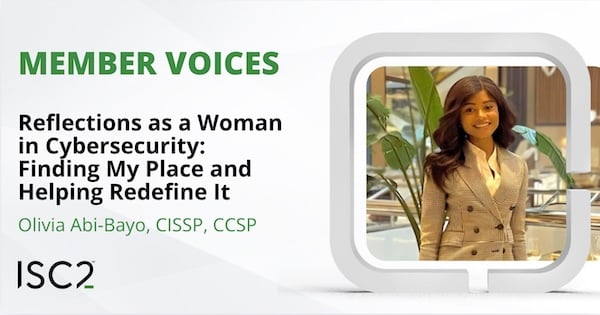
Olivia Abi-Bayo, CISSP, CCSP never set out to become a cybersecurity professional. Operational needs laid the path that led to a new direction and an opportunity to set her own career agenda.
 Disclaimer: The views and opinions expressed in this article belong solely to the author and do not necessarily reflect those of ISC2.
My first experience with cybersecurity was unplanned. I was working as a project manager assigned to remediate audit findings. My role involved gathering evidence, coordinating with engineering and IT, and working through control gaps across multiple stakeholders. At the time, I was focused on delivery. What stayed with me, however, was how cybersecurity connected and sat at the intersection of business operations, technology, governance and accountability.
Those conversations changed the direction of my career. Cybersecurity felt intellectually alive. Technology evolved constantly, regulatory expectations shifted and threats became more sophisticated. The field demanded continuous learning and cross-functional leadership. I decided to move into cybersecurity and I have never left.
Early Lessons
When I joined the field, the gender imbalance was obvious: in many rooms I was one of very few women, sometimes the only one. Over time, I learned that competence alone was not always assumed. Preparation and depth mattered, while being able to articulate risk clearly and confidently mattered even more. In certain environments, I learned quickly that credibility must be established early and consistently.
The landscape has improved significantly over the past decade. There are far more women in technical, governance and executive security roles today than when I began. Inclusion has progressed, even if parity has not yet been achieved. Representation has shifted expectations about who leads in cybersecurity.
The Role of Allies and Sponsorship
Some of the most important accelerators in my career have been allies: leaders who advocated for me in rooms where decisions were being made. Recognition amplifies impact and sponsorship creates opportunity. Equally important has been my choice to work for organizations that invested in my growth. I intentionally sought environments that supported both technical development and leadership capability. Cybersecurity leadership requires fluency in technology, risk management and business strategy, but it also requires communication, executive presence and the ability to influence across disciplines. Developing both dimensions made the difference for me.
I’ve encountered no formal challenges to progression because of being a woman. But it’s true that advancement at senior levels inevitably becomes more complex: visibility increases, expectations expand and decision-making becomes more consequential. Access to sponsorship, transparent promotion pathways and leadership development programs have made a meaningful difference to me in terms of moving into executive roles. As more women step into these positions, the pipeline will surely strengthen for those who follow.
My Advice to the Next Generation
For women considering cybersecurity, my advice is to remain curious and build depth. You don’t need to begin as an engineer to succeed, because cybersecurity spans audit, governance, architecture, operations, privacy, compliance and executive leadership. What matters most is a commitment to continuous learning and the confidence to own your expertise.
What specific moves should you make? I say: invest in your technical foundation. Develop your ability to translate risk into business language. Build networks. Seek mentors and sponsors and do not underestimate the value of your perspective. Diverse thinking strengthens security outcomes.
What gives me confidence about the future is momentum. The number of women entering and leading in cybersecurity continues to grow. Organizations increasingly understand that diverse leadership teams strengthen risk oversight and decision-making. Cybersecurity shapes how trust is built in a digital world; as more women influence that landscape, the industry becomes stronger, more resilient and better prepared for the challenges ahead. The next generation of women entering this field will inherit a more inclusive industry than the one many of us started in. Our responsibility is to ensure it continues to improve.
Olivia Abi-Bayo , CISSP, CCSP has 15 years of experience in IT risk, audit, vendor assessments, and strategic advisory across industries including technology, banking, healthcare and telecommunications. She has led complex cybersecurity and compliance engagements guiding high-impact projects across diverse industries and now brings that enterprise-grade experience to growth-stage organizations.
Global 50x50 Women’s SummitTaking place on March 18, 2026, the Global 50x50 Women’s Summit is a virtual event which will bring together women and allies from every corner of the cybersecurity ecosystem to explore how inclusive leadership, intentional sponsorship, and meaningful mentorship open doors to opportunity and reshape the talent pipeline. Supported by ISC2 and The Centre for Cyber Safety and Education, this event builds on the work of the Global 50x50 Initiative towards a future where women make up 50% of the cyber workforce by 2050. The Summit will highlight the actions needed to create a more resilient and sustainable cybersecurity workforce for all. By attending this live event, you are eligible to receive 3.5 CPE credits. Additional credits can also be earned with on-demand viewing. |