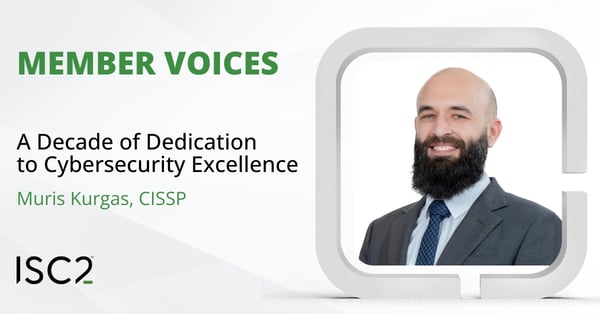
Muris Kurgas, CISSP, discusses his career in cybersecurity and how passing the CISSP exam and being both an ISC2 member and a certified cybersecurity professional have played a major role in developing and honing his skills. Muris is a Director of Cyber Test & Evaluation at CPX, and a trusted advisor to the UAE government.
Disclaimer: The views and opinions expressed in this article belong solely to the author and do not necessarily reflect those of ISC2.
When Muris Kurgas earned the CISSP credential 15 years ago, it marked more than a professional milestone—it was a defining moment in his career. At just 24, Muris became the first CISSP in Montenegro, a distinction of discipline and confidence. “CISSP didn’t just validate my knowledge,” he reflects. “It gave me a structured way to think about security. It forced me to study the fundamentals, to zoom out and understand the entire landscape.”
For Muris, maintaining the CISSP is not about the letters after his name. It’s about what they represent: a commitment to principles in an industry where shortcuts can lead to disaster. “In a time where anyone can claim to be a cybersecurity expert, CISSP signals that this individual understands foundational principles. And in security, principles matter. Resilience cannot be built on shortcuts.”
As an ISC2 member, Muris finds the greatest value in the structure and standards the organization provides. The Common Body of Knowledge (CBK), he says, serves as an anchor in a constantly shifting industry. “It doesn’t chase hype. It reinforces critical thinking, system-level awareness, and ethical responsibility. I’ve used it not just as a study guide, but as a coaching tool to help my team think beyond the exploit.” For Muris, ISC2 offers clarity in a noisy field, providing signal through continuing education, peer community, and a shared ethical framework.
Muris has also played an active role in supporting others on their certification journey, endorsing nearly a dozen CISSP applications. “In those moments, I felt valued,” he says. “It gave me recognition as a trusted member of the global infosec community among peers.”
The global recognition of CISSP has been pivotal in Muris’ career, particularly in bridging the gap between technical depth and executive understanding. “It’s helped me communicate effectively with stakeholders and lent credibility to my recommendations,” he explains. Whether advising a CISO, presenting to a board, or guiding a young consultant, the CISSP framework creates common ground. It has also empowered him to uphold best practices—even when saying ‘no’ meant losing a deal. “Trust can take years to build and seconds to lose,” he notes. “The CISSP designation signals, without words, that I take that responsibility seriously.”
For Muris, CISSP is more than a credential—it’s a commitment to integrity, resilience, and the enduring principles that keep our digital world secure.
Would you like to share your journey to certification? Or share a story about your career development? Learn how to become an ISC2 Insights Contributor.