Can we trust the people in our organizations to always do the right thing? That vendors we’ve engaged for years will always have our backs? That the cybersecurity safeguards and training we deliver will keep the bad actors at bay? Collin Sampson, CISSP, discussed dealing with insider threats and their impact during his session at ISC2 Security Congress 2026.
 Disclaimer: The views and opinions expressed in this article belong solely to the author and do not necessarily reflect those of ISC2.
On the first day of the 2026 ISC2 Security Congress, Collin Sampson, CISSP, CISO at Expion Health delivered
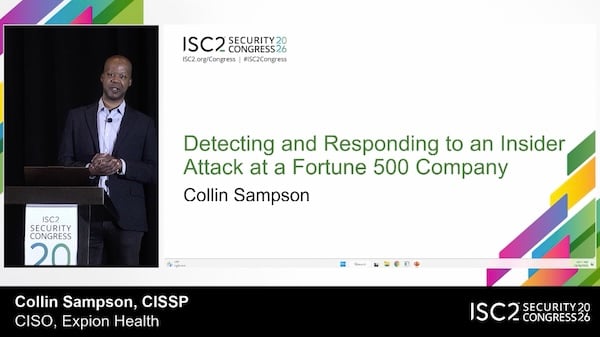
During a riveting session, entitled Detecting and Responding to an Insider Attack at a Fortune 500 Company, Collin Sampson, CISSP, CISO at Expion Health addressed the ongoing challenges posed to organizations and cybersecurity teams by insider threats – whether it’s deliberate or inadvertent.
His first question to the audience was, “How would you have done it differently?” While it can be easy to spot the missteps that led up to an incident after it’s been resolved, it’s not always apparent what should be done in the moment. This session addressed this issue and gave the audience some concrete steps to take when the cybercriminal is someone they trust.
Insider Threats Overview
The vendors who supply our organizations, employees and management are all trusted insiders. As such, insiders can often do more damage than external threat actors, since they have an intimate knowledge of an organization’s processes, assets and controls. But most controls address the threats posed by outsiders.
It can be difficult to recognize unusual behavior. We’re not expecting it from those we trust and what might seem like strange activity might be normal. The burden of proof can be significant and false accusations can have serious consequences. It’s important to strike a balance between being too suspicious and suspicious enough.
Company culture can also be an impediment, since people might be afraid to speak up, fear retaliation, or be called before the legal team. It was Sampson’s opinion that insider threat reporting should be the norm, just as we encourage people to report on suspected phishing, detected malware, etc.
Common Reasons for Insider Attacks
There are many things that motivate faithful colleagues to commit cybercrimes. These motivations fall into two categories: intentional and unintentional.
There are five main motivators for those who are intentional about their misdeeds:
- Coercion: Someone wants to gain leverage to get what they want
- Financial Gain: There’s money to be gained by selling trade secrets or using PII to open lines of credit
- Retaliation: Feeling wronged, overlooked or unfairly treated can drive someone to want to get back at an organization, to “teach them a lesson”
- Competitive Advantage: Insider information can put the odds in one’s favor
- Ego: The cybercrime demonstrates that the perpetrator is smarter than everyone else
Conversely, some insider attacks are unintentional and happen through
- Negligence: Mistakes made by one person can be taken advantage of by another
- Misconfiguration: Incorrectly configured systems or security settings can create vulnerabilities that others may exploit
- Social Engineering: Manipulating people into revealing sensitive information or taking unsafe actions can give attackers access to systems or data
- Excessive Privileges: Giving people more access than they need can increase the damage caused by mistakes, misuse or compromised accounts
- Lack of Policies: Unclear or missing security policies can lead to inconsistent practices and increase the risk of security incidents
Insider Crime in Action
Sampson presented several case studies to illustrate the damage done by insiders, both maliciously and by accident. One example of an intentional action was a sysadmin who stole employees’ personal information and used it to open credit accounts, causing the victims to lose money and bad press for the company, which had no idea of the crime until law enforcement arrived at their doorstep. The sysadmin had avoided detection for a year and a half because after accessing the HR files he copied the employees’ personal information into a notebook, thereby leaving an incomplete data trail. He was fired from his job, the company reviewed and restricted access and provided free credit monitoring to the victims.
An example of unintended consequences was an employee who wanted to see if they could spam the whole company with gibberish email. He was successful, causing major disruptions as everyone’s inboxes were flooded with gibberish emails that distracted them from the legitimate ones. Until this exploit, there were no restrictions on who could send automated emails. After the incident, only specific employees were given this access.
Other Dishonorable Mentions
Sometimes, people’s actions inadvertently lead to opening organizations up for unwanted access or crimes. One person allowed his child to use their company-issued phone, who then achieved a high score in a video game then bragged about it on the company’s X account. Some people deliberately damage company-issued devices; in one instance, a laptop that had been sawed in half was turned over to IT. Leaving unattended, unlocked devices in public is also a problem, as is emailing sensitive data to a personal account and copying intellectual property.
What Can Be Done?
It’s important, Sampson said, to create effective insider threat programs. These programs include background checks of job candidates, continuous credit monitoring, access reviews to ensure that only the right people can get to sensitive information, segregation of duties so an individual doesn’t have outsized control over a process and mandatory vacations.
Additionally, a definition of unusual behavior should be agreed upon. Any reported actions should be verified by a team, not just one person, to lessen the chance of a false positive.
Takeaways and Next Steps
Insider threats are difficult to detect because we trust those who are part of an organization. It’s important to build an insider threat program focused on deterrence, detection, investigation and response. Technical controls must be enhanced with behavioral indicators and least privilege, and access reviews are critical. And we must encourage employee reporting, which is one of the best detection mechanisms.
In the short term, we need to identify critical resources, assess access controls, review monitoring capabilities and update policies and procedures. Long term, it’s important to identify people in high-risk roles, update training programs, reduce the number of people with access and investigate unusual activity.
Insider threats aren’t going away. The key is knowing what to look for and being prepared to act when warning signs emerge.
Learn more about ISC2 Security Congress 2026 Sessions
Virtual and in-person attendees to Congress can see an on-demand replay of the session this article is based on as part of their existing access. On-demand access packages for Congress sessions will be available at a later date.