In his keynote session at ISC2 Security Congress 2026, former lead international kidnapping negotiator for the FBI and now CEO of The Black Swan Group, Chris Voss, discussed applying negotiating techniques to business leadership, cybersecurity and organizational decision-making.
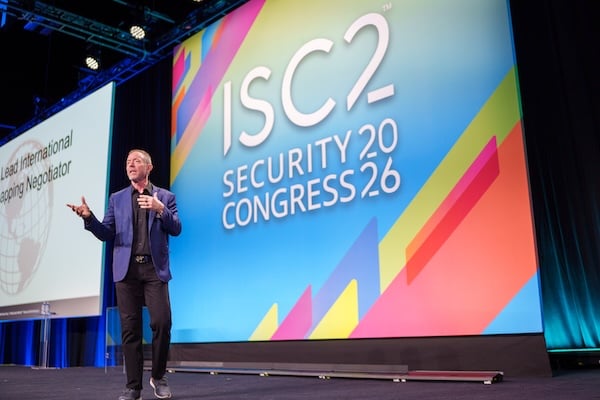 The first topic Voss introduced was human dynamics. The message was clear: human dynamics are common to all of us. “Regardless of pressure, regardless of circumstances, human dynamics just don't change, and there are human dynamics that are baked into us,” he said. Regardless of our background, origins, ethnicity, diet, anything, everything about us is built on top of the fact that we are human, which means that by default we all react in largely the same way to a given set of circumstances. As Voss put it: “Before you were Irish, before you were German, before you were Latino, before you were anything, you were human,” so there is a set of emotions that we are all born with.
The Art of Communication
Voss questioned how we think of communication and posed the question: if we are talking, does that necessarily mean we are communicating? He drew a distinct line between communicating with someone and communicating at them. Voss used this as a prologue to a discussion about negotiation. The hypothesis presented was that “the most dangerous negotiation is the one where you think they know what they want.” You or another party can only negotiate successfully when you or they have all the facts. That is seldom the case. So, given that both parties seldom share all the facts, whatever you think you want is by inference always based on flawed information. Why do we hold information back, he asked. The answer was simply that to give information changes the circumstances, gives the other party leverage, and enables them to make us do things. Giving information can put us on the back foot.
Voss quoted Hollywood executive Robert Evans, who is generally accepted as the source for the quotation “There's three sides to every story: your side, my side and the truth”.
The goal, he said, was not to do with our side of the story or the truth, but to articulate the other party’s side – specifically, to make the other party feel that we understand them. He then put this in the context that despite having negotiated “literally in every continent, in every culture there is,” this does not mean he speaks a plethora of languages. Instead, his approach has been to find someone in each case who is, to use his word, “coachable” – that is, someone whom he can work with to fill the language and culture gap. As he explained it: “I understand human dynamics that are universal because people are human, and the influences, the triggers, that happen that cause human decision making under all circumstances. You understand your market”.
The subject matter then turned to how the human brain is wired. Voss took the audience through a simple exercise involving some basic hand movements, the point being that everyone initially found them quite tricky but decreasingly so over time. This, he said, was an example of neuroplasticity, whereby intentional movement causes new neural connections in the brain and the more an action is taken the better the connection becomes. He added that the age of 25 tends to be the end of the developments of certain parts of the brain. Once we have passed 25 we feel far more awkward trying new things. Bringing this back to the original subject – communication – Voss pointed out: “That's why you won't change your communication strategies – because it feels awkward and you don't like it.” This took us to the next step: “embracing” awkwardness, which we must do if we are to learn. “The feeling of awkwardness is actually an indicator of accelerated learning,” said Voss, so “if you're trying to learn something and you don't feel awkward, you're learning at a slower rate, if at all. So, I embrace the discomfort because I know I'm learning faster”.
Negotiating and Dispensing with Common Ground
The thread then turned to the core topic of the talk: negotiation. The first thing Voss did was to dispose of the idea that relationships are built based on common ground: while we may have things in common with our friends, there is no common ground for, say, an FBI negotiator and an Al Qaeda kidnapper. In fact, he said, common ground is the enemy of negotiation and is to be shunned at all times. Voss gave an example of a delayed flight: 300 people arriving in an unfamiliar location where the gate staff have gone home and one solitary staff member is trying to cope with an unhappy crowd of passengers, one of whom is having a major rant at the sole staffer. The temptation might be to calm the ranter by showing the common ground – that everyone is in the same boat – but Voss contended that the result would be highly sub-optimal and that the ranter would tell you where to go. “When you jump in with your story, it makes you feel good”, he said, because it releases oxytocin in the brain. Oxytocin, he added, inclines you to tell the truth. Also, research has shown that rapport-based interviewing is highly effective, because if we have a rapport with someone – rather than just telling them we understand – their oxytocin will be flowing and they will be inclined to tell us the truth.
Asking the Right Questions
Moving on, Voss embarked on a case study. The scenario was simple: an American person had attempted to connect, based on a perception of common ground, with a sociopath terrorist who proceeded to kidnap them and demand a $10 million ransom – which the kidnapper referred to as “war damages”. He then introduced the local negotiator whom he had engaged with to deal with the situation; the latter was the leader of the Philippine National Police Special Action Forces (SAF) and had conducted 30 or so military-style rescue missions but was, to return to the word Voss introduced earlier, “coachable”.
Heading down an aside, Voss explored commonly-taught techniques for selling to people – how we can ask questions to which the recipient can only really ever say “yes”.
“You've all been yes battered”, he pointed out. “There isn't a human being on earth in any culture this hasn't caught on and been used against us. Yes has been weaponized against us. There’s a hook coming.” On the other hand, though, asking what we think are “good” non-yes questions can lead to deep thinking that takes too long for the window of opportunity open to us. Voss gave an example of a book signing by Jack Welch, the former CEO of GE, whom he was keen to snag to talk on a course he was running at USC. Avoiding “yes” questions and non-yes questions that would take too long to answer, he instead asked Welch: “Is it a ridiculous idea for you to come and speak to the negotiation course I teach at USC?”. The point was that he was hoping for a simple, one-word answer: “No”. In fact, Welch paused and then put Voss in touch with his PA to work something out so that the talk could happen. Voss noted that the approach worked “Because you feel safe and protected when you say no”, so why not approach people with questions that you want them to answer in that way. An example he cited was an Obama fundraising campaign: changing from three “yes” questions to three “no” questions brought a 23% uptick in contributions. Another example saw a company’s sales team go from a 12% success rate to 60%.
Overcoming Underlying Motivations
Switching back to the kidnapping mentioned earlier, Voss pointed out that the “war damages” being demanded had nothing to do with anyone involved in the situation. The kidnapper’s grievance was nothing to do with the present day but was his discontentment with a history of 500 years of persecution and economic harm. After some days of fruitless negotiation, Voss decided that: “We're going to get a ‘that's right’ out of the bad guy. We're going to articulate his story back to him, especially the stuff that's bad about us.” He coached his local contact to lay everything out to the captor, and then to be quiet and wait, on the premise that most people are unable to abide silence for very long. The negotiator called the kidnapper, spent a great deal of time setting out the situation with a large number of observations and at the end of it all the captor paused and said: “That’s right”.
This was a watershed moment; the ransom demand was dropped, and after some more discussions they let the hostage go and he walked away.
There was an unexpected epilogue to the kidnapping story, though. A few days after the situation had concluded, the captor called the negotiator (who still had his under-cover phone and name) and told him: “You're really good. They should promote you,” before hanging up. “What's he saying in that moment?” asked Voss. The answer was: “We're good. I would deal with you again. The application of this does not weaken your position in any way. You can become the immovable object in a negotiation and simultaneously the irresistible force, because we were the irresistible force and the immovable object simultaneously and people will still deal with you again”.
Voss concluded: “Think about the longevity this creates in your career and your profession. Think about what it does for your soul, and the people that are around you”.
Learn more about ISC2 Security Congress 2026 Sessions
Virtual attendees to Congress can see an on-demand replay of this keynote as part of their existing access. On-demand access packages for Congress sessions will be available after the event.