In the first of three articles looking at the cybersecurity contribution of the U.S. over the last 250 years, we begin with a look back to the beginning, where innovative and extensive use of encryption and cryptographic techniques contributed to the outcome of the American Revolutionary War and the establishment of the U.S. as an independent and self-governing nation.
The American War of Independence is often remembered through iconic battles, famous political declarations and legendary figures such as George Washington and Benjamin Franklin. However, behind the military campaigns and diplomatic negotiations that followed the Declaration of Independence was a less visible but equally important struggle: the battle to protect information. Intelligence gathering, secret communications, coded messages and cryptographic techniques played a critical role in the success of the American move for independence from the kingdom of Great Britain. Long before computers, networks and digital encryption algorithms existed, the leaders of the emerging U.S. understood a timeless truth of security: information is power and protecting that information can determine the outcome of a conflict.
The American Revolution offers some of the earliest examples of organized American cryptographic practice. Patriot leaders developed systems of codes, ciphers, and clandestine communications to conceal military plans, coordinate espionage networks and deceive British forces. While the technologies of the 18th century were primitive by modern standards, the principles behind them remain familiar to today's cybersecurity professionals. Confidentiality, authentication, secure communications and intelligence protection methods that were perfected during the conflict were as important in 1776 as they are in the digital age.
Moreover, the revolutionary experience helped establish a tradition of valuing secure communications and intelligence operations that would continue throughout American history. From wartime codebreaking and cryptography to the development of modern encryption standards and cybersecurity technologies, the U.S. has repeatedly demonstrated technical leadership in protecting and securing information. The roots of that leadership can be traced back to the nation's founding struggle.
Cryptography in an Age Before Computers
During the 18th century, military communications depended on handwritten letters carried by messengers, ships, or horseback riders. Messages could easily be intercepted, stolen, copied, or delayed. The British maintained extensive intelligence networks throughout the colonies, and American leaders faced the constant threat that their plans might be discovered before they could be executed.
To counter this risk, the Patriots employed a variety of cryptographic and steganographic techniques. Cryptography refers to the use of codes and ciphers to transform information into an unreadable format, while steganography involves concealing the very existence of a message, by hiding it inside something else. Both approaches were widely used during the Revolution.
Simple substitution ciphers were among the most common methods. In these systems, letters or words were replaced with alternative symbols, numbers, or characters according to a predetermined key. Anyone intercepting the message would see only meaningless text unless they possessed the correct key.
Codebooks were also used to replace entire words or names with numerical values. Military leaders, cities and strategic locations might each be assigned a specific number. Such systems not only obscured the content of communications but also made messages shorter and easier to transmit.
Invisible ink represented another important innovation. Secret writing solutions allowed messages to be concealed between the lines of ordinary correspondence. A seemingly harmless letter discussing family matters could contain hidden intelligence visible only after the recipient applied a special chemical reagent.
These techniques reflected an early understanding of operational security. The Patriots recognized that safeguarding communications could provide a decisive advantage against a stronger and better-equipped opponent.
George Washington and the Importance of Intelligence
No revolutionary leader appreciated the value of secure communications more than George Washington. Throughout the war, Washington repeatedly emphasized the importance of intelligence gathering and information protection. He understood that knowledge of British troop movements, logistics and intentions could help offset the Continental Army's disadvantages in manpower, training and resources.
Washington frequently instructed his officers to use coded communications whenever possible. He also encouraged the development of spy networks that could operate within British-controlled territory. Maintaining secrecy was critical. If a spy's identity were exposed or communications intercepted, entire intelligence operations could collapse.
For Washington, information security was not merely an administrative concern; it was a strategic necessity. Many historians argue that his sophisticated use of intelligence significantly contributed to American success. His approach demonstrated an early recognition that military power and information security are deeply interconnected.
The Culper Spy Ring
Perhaps the most famous American intelligence network of the Revolutionary War was the Culper Spy Ring. Established in 1778 under Washington's direction, the network operated primarily in British-occupied New York and provided valuable intelligence to the Continental Army.
The ring employed numerous security measures that would appear familiar to modern intelligence and cybersecurity professionals. Members used aliases rather than their real names. Numerical codes represented individuals, locations and military concepts. Messages were transmitted through carefully controlled channels designed to reduce the risk of interception.
One of the most notable features of the Culper Spy Ring was its use of a codebook developed by Major Benjamin Tallmadge.
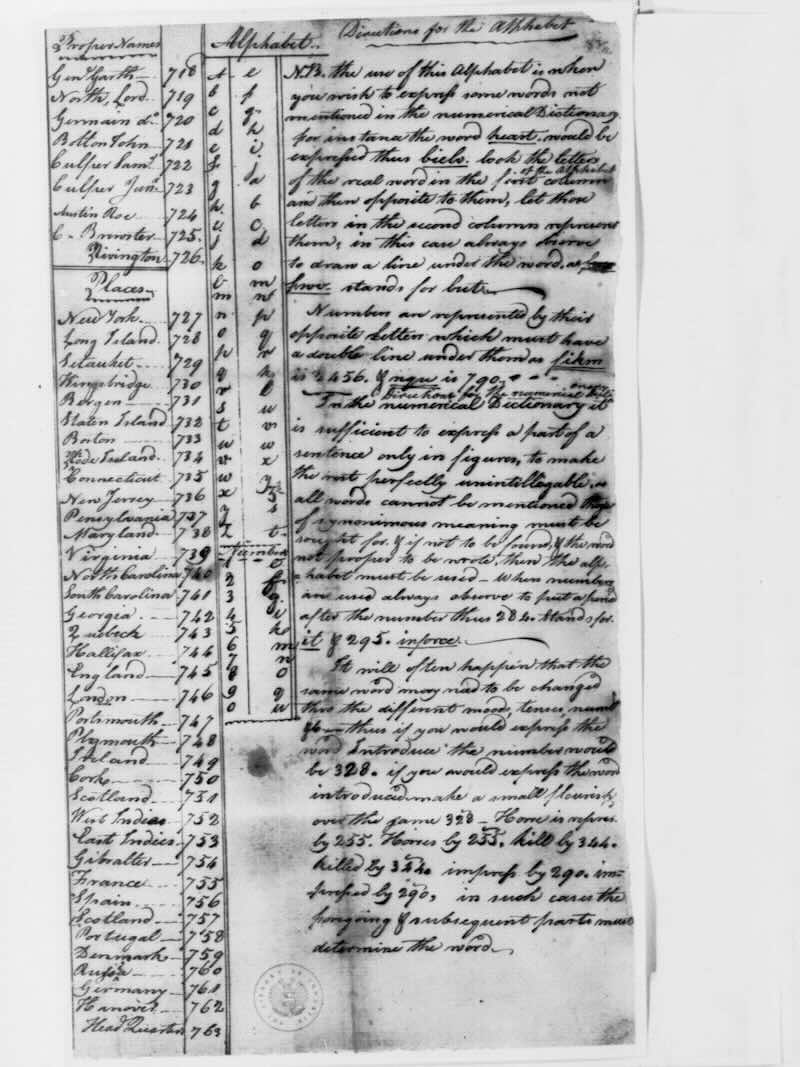
The codebook assigned numerical values to hundreds of words, names and places. George Washington himself was assigned the code number 711, while New York received its own numerical designation.
The ring also relied heavily on invisible ink. Washington was a strong supporter of invisible ink and repeatedly encouraged its use among his intelligence agents, often referring to the secret-writing compound as "sympathetic stain." Messages written using the stain appeared blank until treated with a corresponding chemical solution. This allowed intelligence reports to pass through British checkpoints disguised as ordinary correspondence.
Washington reportedly requested ever larger quantities of sympathetic stain as the war progressed because intelligence operations were expanding, such was his believe that secure communications were critical to the effectiveness of his spy networks.
The Culper Spy Ring's combination of cryptography, steganography, compartmentalization and secure communication procedures enabled it to operate successfully for years. Many of the principles it employed remain foundational elements of modern intelligence operations.
Benjamin Franklin and Diplomatic Security
Benjamin Franklin is often celebrated as a statesman, inventor and diplomat, but he also understood the importance of secure communications. During his diplomatic missions in Europe, Franklin relied on encrypted correspondence to communicate with American leaders and foreign allies.
Diplomatic communications were particularly vulnerable to interception. European powers routinely monitored mail and sought access to sensitive political information. Franklin and his colleagues therefore used ciphers and coded language to protect negotiations and military discussions.
Securing communications with France was especially important. French support proved crucial to the American war effort, ultimately contributing to the defeat of the British. Protecting diplomatic exchanges ensured that sensitive negotiations could proceed without providing intelligence advantages to Britain.
Franklin's efforts reflected a broader reality of the Revolutionary War: victory depended not only on military action but also on the secure management of information across vast distances.
Information Security and the Defeat of the British
While cryptography alone did not win the war, it played an important supporting role in several successful American operations. Secure communications enabled commanders to coordinate troop movements, share intelligence and maintain strategic surprise.
One of the greatest dangers facing any military force is the compromise of operational plans. If an adversary knows where troops will move or when an attack will occur, the effectiveness of those operations can be severely reduced. By employing codes, ciphers and secret communications, American leaders limited the ability of the British to exploit intercepted information.
The Revolution demonstrated a principle that remains central to cybersecurity today: security is often measured not by what an organization can do, but by what it can prevent an adversary from learning. The Patriots' ability to protect sensitive information helped preserve flexibility, maintain secrecy and exploit intelligence advantages throughout the conflict.
Building an American Tradition of Cryptography
The conclusion of the Revolutionary War did not end America's reliance on cryptography. Instead, it established a foundation upon which future generations would build.
Throughout the 19th century, the U.S. continued to employ coded communications in military, diplomatic and governmental contexts. During the American Civil War, both Union and Confederate forces used increasingly sophisticated cipher systems. As communications technologies evolved from handwritten letters to telegraphs and radio transmissions, the importance of cryptography grew correspondingly.
The 20th century marked a dramatic expansion in U.S. cryptographic capabilities. During both World Wars, the U.S. invested heavily in codebreaking and secure communications. American cryptanalysts helped decipher enemy messages, while engineers developed increasingly advanced encryption systems to help protect Allied communications, while British cryptographers worked on breaking the German Enigma code.
Alongside this, American cryptanalysts achieved code-breaking success of their own by breaking Japanese diplomatic and military codes, including the Purple cipher system. American cryptanalysts' ability to read portions of Japanese communications contributed to strategic decision-making throughout the Pacific War.
American leadership in encryption and cryptography did not emerge overnight. Following the foundations laid during the Revolutionary War, U.S. government agencies, universities and private companies have played major roles in many of the most important cryptographic breakthroughs of the modern era.
Government-Led Innovation
The U.S. government's first major peacetime cryptographic organization was the Cipher Bureau, commonly known as the "Black Chamber," established after World War I.
Led by Herbert Yardley, the organization successfully broke diplomatic codes used by foreign governments, demonstrating the growing strategic importance of cryptography and cryptanalysis.
The U.S. also developed advanced secure communications systems, including the SIGSALY system, often considered the world's first practical secure digital voice encryption system. Developed with engineers at Bell Labs, SIGSALY used concepts that anticipated many modern digital communications technologies. The 1949 paper, Communication Theory of Secrecy Systems by Claude Shannon at Bell Labs is regarded by many as the foundation of modern cryptography, itself drawing from many of the fundamentals used and perfected in the 18th century in the Revolutionary War.
The creation of the National Security Agency (NSA) in 1952 marked a major turning point in U.S. government-led cryptographic research.
The NSA became one of the world's largest employers of mathematicians, computer scientists and cryptographers. Its classified research has contributed to a wide array of modern cryptographic algorithms, secure communications systems, cybersecurity defense technologies and, more recently, quantum cryptography research.
Although much of the research performed by the NSA remains classified, its influence on both national security and commercial cybersecurity has been substantial.
From Military Codes to Modern Encryption
The digital revolution transformed cryptography from a specialized military discipline into a fundamental component of everyday life. Today, encryption protects online banking, ecommerce, healthcare records, government communications and personal messaging applications.
Many of the world's most influential cryptographic developments have strong connections to the U.S. Researcher and U.S.-based organizations have played major roles in the development and adoption of public-key cryptography, secure network protocols and encryption standards. Technologies such as RSA encryption, Secure Sockets Layer (SSL), Transport Layer Security (TLS), and the Advanced Encryption Standard (AES) have become foundational elements of global cybersecurity.
U.S. universities, technology companies and government agencies continue to drive innovation in fields such as quantum-resistant cryptography, secure cloud computing and digital identity management. The U.S. remains home to many of the world's leading cybersecurity firms and research institutions.
Although modern encryption relies on advanced mathematics rather than invisible ink and handwritten codebooks, the underlying objective remains unchanged: ensuring that information can be accessed only by authorized parties.
The Legacy of Revolutionary-Era Cryptography
The cryptographic activities of the American Revolution may appear simple when compared with today's sophisticated cybersecurity technologies, but they represented an important beginning. Revolutionary leaders recognized that information security was essential to national security, military success and diplomatic effectiveness.
The use of coded messages, secret writing and organized intelligence networks demonstrated an early American commitment to protecting sensitive information. Figures such as George Washington, Benjamin Franklin, and Benjamin Tallmadge understood that secure communications could provide strategic advantages against powerful adversaries.
Over the subsequent 250 years, that commitment evolved into a national tradition of innovation in cryptography and cybersecurity. From Civil War signal corps operations to World War II codebreaking, from Cold War intelligence programs to modern digital encryption standards, the U.S. has repeatedly invested in the invention and development of technologies designed to protect information and communications.
As the world confronts contemporary cybersecurity challenges including ransomware, cyber espionage, artificial intelligence-enabled attacks and the potential impact of quantum computing, the lessons of the Revolutionary era remain relevant. The technologies have changed dramatically, but the fundamental challenge remains the same: protecting critical information from adversaries.
The story of American cryptography did not begin with computers or the internet. It began with handwritten letters, invisible ink, numerical codes and determined patriots seeking to keep their plans hidden from the British Empire. Those early efforts helped secure American independence and laid the foundations for a cybersecurity tradition that continues to influence the world today.