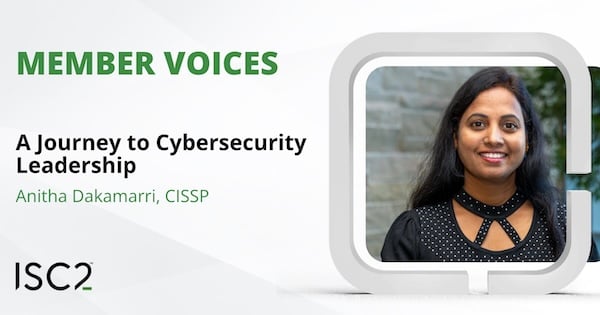
Anitha Dakamarri, CISSP, shares her cybersecurity career story, explaining that when people introduce her today, they often do so by using terms like seasoned information security leader, public speaker, mentor, contributor, security strategist, threat modeling expert and so on. When they do, it serves as a reminder of her own path, one that many others have also trodden, to reach her current cybersecurity leadership role.
 Disclaimer: The views and opinions expressed in this article belong solely to the author and do not necessarily reflect those of ISC2.
I didn’t grow up with the luxury of an easy childhood, or even with the certainty that my future would be my own. By the age of eight I’d developed a fierce determination that my life would not be dictated by fear, silence, or circumstance. At 13, I was expected to give up my education for marriage – but I knew, even then, that I wanted more. I wanted education. I wanted independence and a life built on my own choices, not someone else’s convenience.
My decision to refuse a future that would limit me became one of the most defining moments of my life; it was the first time I chose myself fully and without apology. That determination has gone on to define every decision I’ve made, every boundary I’ve set and every goal I’ve pursued.
Changing My Path with Education
As a young girl, I dreamed of becoming a successful, independent woman – which, to me, means the freedom to think, to learn, work and live without fear. I believed deeply that education would be my way forward, my shield and my key, so I studied relentlessly. While others saw education as an obligation, I saw it as survival and transformation.
Every exam I passed, every concept I mastered, strengthened my belief that I could build a life rooted in knowledge and self‑reliance.
This self-leadership carried me through higher education and, ultimately, to a master’s degree in computer science. But the world of technology was more than a career choice; it was a declaration. I was stepping into a field that demanded logic, resilience and the continuous learning qualities I had been developing my entire life. Consequently, my first job wasn’t just employment; it was validation: proof that my hard work had meaning, that my past did not define my ceiling, and that I belonged in professional spaces which, frankly, once felt unreachable. From that moment on, I committed to excellence. I didn’t just want to succeed, I wanted to master my craft.
But cybersecurity leadership is not an overnight achievement, there are also no shortcuts. I have built a career in information security over nearly two decades, a field that requires vigilance, responsibility and integrity. I’ve specialized: in threat modeling, application security assessments and network security assessments, working across complex environments where trust and precision matter deeply. I’ve worked with respected organizations such as DFIN, US Cellular, and Syntel. Over time and with experience, I moved on from the execution of tasks to lead teams, develop security standards and implement robust security frameworks that protect critical systems and data.
To stay effective and credible in my field, I’ve pursued and earned multiple industry recognized certifications, including ISC2’s CISSP. Certifications are not just letters after my name. They represent discipline, persistence and an ongoing commitment to learning in a field that evolves daily.
Cybersecurity Leadership Is Not a Pinnacle to Reach, but a Mindset to Pass On
Technical skills are, though, just part of the story. I strongly believe that a key responsibility of any cybersecurity leader is to help develop the next generation of leaders. There are many ways to do this; personally, I’m deeply committed to education, mentorship and community building, and I’ve put my efforts into those. For example, I’ve:
- initiated and conducted security awareness workshops in schools, helping individuals and organizations understand risks and protect themselves; knowledge should be shared, especially to empower others.
- volunteered with the Treasured Vessels Foundation (TVF) as part of its sex trafficking survivor support program, helping survivors rebuild confidence, safety and independence, and demonstrating to survivors that deserve and are capable of dignity, opportunity and a future defined by choice.
- served as a Teaching Assistant through Microsoft TEALS, supporting computer science education in high schools. Education has always been transformative in my own life; working directly with students and teachers, I was able to help by bringing real world technology knowledge into classrooms that otherwise lacked access to industry professionals.
- been an active public speaker, to educate, inspire and often challenge long‑standing norms in cybersecurity and leadership. Speaking on stages and panels, I’ve advocated for inclusion, ethical security practices and the importance of diverse voices in shaping the future of technology.
- partnered with Black and Scot from the U.K. to deliver DevSecOps education to university students and community audiences.
- contributed to OWASP open-source security standards, helping the wider community adopt better security practices.
- volunteered and contributed to global professional organizations including ISC2, ISACA, WiCyS and Women4Cyber (U.K.), helping to mentor the next generation of women working in cybersecurity.
There are myriad opportunities to develop the next generation of leaders, wherever you are in the world. Even simple mentorship and advocacy will make a huge difference to someone.
What is Cybersecurity Leadership?
With hindsight, my journey from eight-year-old girl to being introduced as an information security leader, public speaker, mentor, contributor, security strategist or threat modeling expert seems implausible, even to me. But the fact is that the child who escaped a marriage proposal aged 13 now implements robust security frameworks for massive corporations.
My journey illustrates how leadership is not merely about authority. It’s about accountability and empowerment, to and of yourself. Knowing what it feels like to be unheard, I choose to lead in a way that amplifies voices, builds confidence and creates safe professional environments. This is what I think it means to be a cybersecurity leader.
Anitha Dakamarri, CISSP, has 17 years’ experience in various security domains, including threat modeling, application security, network security and risk assessments. She has held technical and management roles, with responsibility for penetration testing, security assessments, vulnerability management and building teams and processes. Her cybersecurity work spans the development of security standards and the implementation of robust security frameworks.
.png?h=420&iar=0&w=420)