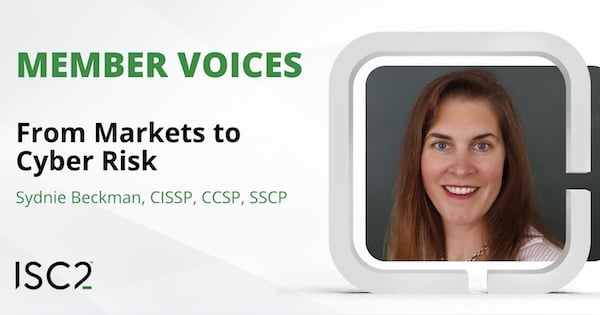
Cybersecurity is often perceived as a technical discipline, reserved for engineers and computer scientists. Many of the most important cybersecurity decisions today are business decisions – ones that involve governance, risk management and strategic judgment. The career journey of Sydnie Beckman, CISSP, CCSP, SSCP, into the field reflects that evolution.
 Disclaimer: The views and opinions expressed in this article belong solely to the author and do not necessarily reflect those of ISC2.
Early in my career, I worked as a trader and developed a strong analytical mindset that thrived on solving complex problems and processing large amounts of information quickly. I was drawn to environments where decisions mattered and where understanding risk was essential.
From there I moved into operational risk at a global bank. In that role I began to see firsthand how technology failures could quickly become business failures, impacting capital, reputation and trust. As financial institutions became increasingly dependent on digital infrastructure, it became clear that the largest emerging operational risks were tied to information security and technology resilience.
Career Changing from Risk to Cybersecurity
That realization led me to transition from operational risk into cybersecurity. I brought with me a background grounded in governance, risk management and business decision-making, and expanded my expertise in cybersecurity governance, risk and compliance (GRC). Rather than starting from a purely technical foundation, I approached cybersecurity as a discipline of managing complex risk within organizations – far from a technical pathway into cybersecurity.
Today, cybersecurity risk influences how organizations grow, transact and meet their obligations to investors, regulators and the public. Being able to guide leaders through those decisions makes the work both challenging and meaningful; cybersecurity has evolved from an IT issue into a board-level accountability.
Weaving Technical and Business Skills Together
It’s a misperception that successful cybersecurity leadership needs you to be the most technical person in the room. While technical expertise is critical within security teams, some of the most impactful cybersecurity decisions are made at the executive and board level. Being a cybersecurity leader means I must be able to translate technical risk into business consequences and guide organizations toward informed decisions.
As a woman in cybersecurity, I’ve also learned that credibility is sometimes evaluated less on substance and more on communication. Early in my career, this meant I had to be exceptionally prepared: to be clear, structured and outcome-focused when presenting cybersecurity risks to executives and boards. Over time, that discipline became one of my strengths. The ability to communicate complex risk in a way that enables action is one of my most valuable cybersecurity leadership skills.
Also early in my career, whether in London or Singapore, there were fewer women in senior roles within risk and cybersecurity. During my time in it, the industry itself has evolved significantly: women in leadership positions are far more visible and there’s broader recognition that effective cybersecurity requires diverse perspectives and leadership styles. However, progress is still uneven.
Inclusion as a Business Discipline
Organizations that make the most meaningful strides toward inclusion do so when they treat cybersecurity as a business discipline rather than solely a technical function. When cybersecurity is viewed through the lens of governance, strategy and enterprise risk management, it naturally opens pathways for professionals from a wide range of backgrounds including finance, law, compliance and operations. In other words, for people like me.
Transferable skills were central to my transition into cybersecurity and to my success within it. I’ve always been drawn to complicated problems that require thoughtful solutions and approach challenges almost like puzzles: breaking them down, analyzing the moving pieces and working toward a clear resolution. That curiosity and desire to constantly learn led me deeper into emerging areas of cybersecurity, particularly cloud security as organizations rapidly adopted new technologies.
Continuous Education and Development
Professional certifications helped reinforce that expertise, and are valuable not simply as credentials, but as tools that help bridge conversations between technical experts and business leaders. Certifications reinforce credibility and allow discussions to focus on the substance of cyber risk rather than the legitimacy of the advisor. Achieving the CISSP provided validation of my knowledge and gave boards and executives confidence in my technical grounding. As cloud computing became central to modern infrastructure, I pursued the CCSP to deepen my understanding of cloud security risks and governance.
Earlier in my career, there were moments where I felt I had to work harder to be taken seriously. Preparation became the equalizer. When cybersecurity risk is clearly connected to regulatory obligations, financial exposure or transaction outcomes, the conversation shifts quickly and cybersecurity stops being theoretical and becomes a tangible business issue. That shift creates meaningful opportunities for women to lead with clarity, perspective and confidence.
Advice for Pursuing a Cybersecurity Career
For any woman considering a career in cybersecurity, my advice is simple: do not underestimate the value of your non-technical skills. Cybersecurity needs professionals who understand governance, finance, law and human behavior just as much as it needs technical specialists.
I’d also encourage practitioners to seek opportunities that expose you to decision-makers early. Learn how boards think about risk and accountability and invest in credentials that complement your experience; they can create leverage and open doors, especially in high-stakes environments.
Most importantly, stay curious and follow what genuinely interests you. If you remain curious, you’ll continue learning; if you pursue areas that truly engage you, work rarely feels like work. Cybersecurity is a vast field, there is room to carve out your own niche. Explore the problems that intrigue you most and lean into them.
Sydnie Beckman, CISSP, CCSP, SSCP, has over 20 years’ experience across capital markets, financial services, cybersecurity governance, mining and energy. She has held business and management roles, with responsibility for cyber risk governance, regulatory strategy, board advisory and capital markets transactions. Her cybersecurity work spans advising resource and defense-adjacent companies on cyber risk affecting investment decisions.