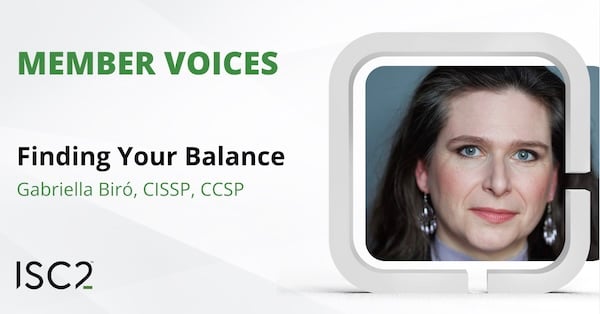
Dancing teaches discipline, confidence and how to command a stage – skills that translate surprisingly well to the boardroom. Being a professional doesn’t mean hiding your personality or your femininity, argues Gabriella Biró, CISSP, CCSP.
 Disclaimer: The views and opinions expressed in this article belong solely to the author and do not necessarily reflect those of ISC2.
Family lore has it that, at the age of three, I announced I’d be a programmer, inspired by watching my father work as a system programmer. I followed that path faithfully, studying Computer Science at university with every intention of becoming a developer. But then, a single seminar on IT security changed everything. I realized that, while I loved the logic of building systems, I was even more drawn to the complex, high-stakes puzzles of protecting them. I decided right then that I wanted to work in security, a field which at that time barely had a name.
Some people get their rush from physical sports; I get mine from mental exercise. Cybersecurity offers that in abundance. Through hard work, I rose to become Head of IT Supervision at the Central Bank of Hungary, where I was responsible for evaluating the security of an entire nation’s financial sector: banks, insurance companies and pension funds. We weren't just checking boxes; we were issuing guidelines on cloud usage and secure remote work and acting as the primary go-to experts for financial cyber matters in the country.
Cybersecurity as a Catalyst for Further Education
The sector’s constant evolution has never faded. Today, after more than 20 years in cybersecurity, I’m channeling my curiosity into a PhD in Military Engineering, researching the intersection of cyber warfare and modern conflict. The scope of our work changes, but the core challenge – analyzing complex systems and solving problems – remains the same.
Pushing Back Against Stereotypes
When I started, the industry looked very different. I often faced those unspoken barriers that many women in cybersecurity recognize. The most pivotal moment for me came years ago at a major conference. The organizers, assuming that the women in attendance were only there to accompany their spouses, introduced a "wife ticket." This moment of exclusion became a catalyst. Nine of us sat down and decided we wouldn't just complain; we would build the table we wanted to sit at. We founded WITSEC (Women in IT Security), with a mission to make female professionals visible and to banish the idea that we are merely "guests" in this industry.
We’ve come a long way since then. The conversation has shifted from "Are women allowed?" to "How do we leverage diverse perspectives?" We are seeing more women in the room, though we still have work to do to break the glass ceiling at the executive level.
My Advice to Others
If I could offer advice to women entering the field today, it would be “Don’t let anyone dissuade you.” There will be voices that tell you this is not a place for you; ignore them. While my professional life is defined by strict regulations, audits and zero-tolerance for error, outside of work, I’m a belly dancer. It might seem like a contradiction – the serious CISO and the creative artist – but for me, it’s a necessary balance. Dancing also teaches me discipline, confidence and how to command a stage, skills that translate surprisingly well to the boardroom. It reminds me and hopefully others that being a professional doesn’t mean hiding your personality or your femininity.
Perhaps the most misunderstood part of working in cybersecurity is the idea that you must be hyper-technical to be taken seriously. You do not need to be a ‘techie’ in the traditional sense to succeed; cybersecurity needs psychologists, lawyers and communicators just as much as it needs coders.
My mother gave me the best advice for leadership: "You can be a leader but never expect the same from your people as you expect from yourself." I’d add that you need to be true to yourself and not try to fit a masculine mold to be taken seriously. We don't need to emulate the leadership style of men to be effective. Find your own voice, find your own balance and find a community that supports you. The future of cybersecurity is not just about better firewalls; it is about better thinkers. We need all of you there to help us solve the puzzles of tomorrow.
Gabriella Biró, CISSP, CCSP, has 22 years of experience in the financial sector, academia and global consultancy services. She has held management and technical roles, with responsibility for securing financial systems and overseeing IT security compliance across the sector. Her cybersecurity work spans civilian-defense collaboration, cyber warfare research, and advocating for women.