Is SSCP Right for You?

What Is SSCP?
SSCP Validates Operational Capability
Security operations never stop. When threats emerge at 3 a.m., incidents disrupt operations or systems go down — organizations need professionals who can execute under pressure.
SSCP validates that operational security capability.
Systems Security Certified Practitioner (SSCP) demonstrates that you can implement, monitor and administer security operations based on proven hands-on experience — not just theoretical knowledge.
The SSCP Difference: One year of operational experience is required. This ensures SSCP validates what you can execute under pressure, not just what you've memorized from study materials.
What SSCP Validates
Operational capability |
Sound judgment |
Continuous learning |
Professional accountability |
Organizations worldwide trust SSCP professionals to keep security operations running. Always operational. Always ready.
ANAB-Accredited, ISO/IEC Standard 17024, DoD 8140-Approved
![]() |
Is SSCP Right for You?SSCP is built for security operations professionals with hands-on experience who want to validate their operational capability. |
You're a strong candidate if you:
|
|
SSCP is also valuable for:
![]()
Military and DoD Cybersecurity Professionals
Pursuing DoD 8140 qualification, seeking to complement Security+ with operational validation or building credentials for civilian career transition.

![]()
Career Advancers
Looking to move into senior operational roles, team lead positions or demonstrate proven expertise to employers.

![]()
Security+ Certified Practitioners
Ready to demonstrate operational capability beyond institutional knowledge through experience-based certification.
What You Need to Earn SSCP
Experience Requirement
One year of cumulative, paid work experience in one or more of the seven SSCP domains. A bachelor's or master's degree in cybersecurity or related field can satisfy the experience requirement.
The 7 Domains
SSCP validates operational capability across seven comprehensive domains:
Security Operations and Administration
Implementing and managing security controls, monitoring systems, maintaining operational security
Access Controls
Managing authentication, authorization and accountability systems
Risk Identification, Monitoring and Analysis
Identifying vulnerabilities, assessing risk, monitoring threats, analyzing security events
Incident Response and Recovery
Detecting, responding to and recovering from security incidents
Cryptography
Implementing cryptographic controls, managing encryption systems
Network and Communications Security
Securing network infrastructure, monitoring network traffic, managing network access
Systems and Application Security
Securing systems and applications, managing security in development and deployment
SSCP for Military + DoD Cybersecurity Careers
DoD 8140-Approved
SSCP meets DoD 8140 Intermediate operational work role requirements (Advanced for technical support specialists).
Complements Security+
Think of it this way:
- Security+ = Basic Training (institutional knowledge every cybersecurity professional needs)
- SSCP = Operational Qualification (capability proven through hands-on experience)
Both necessary. Both DoD 8140-approved. Together: Complete operational professional.
Dual Value for Your Career
|
Current Military/DoD roles:
|
|
Future civilian careers:
|
Reserve components: One certification validates operational capability in both your military role and civilian employer context.
What You Gain with SSCP
![]() |
|
![]() |
|
![]() |
|
How SSCP Compares
SSCP vs. Security+
Security+
Validates institutional knowledge (concepts, frameworks, procedures). No experience required. Entry-level baseline certification.
Validates operational capability (execution with judgment). 1 year experience required. Practitioner-level certification.
Both valuable. Security+ proves you understand concepts. SSCP proves you can execute them based on hands-on work. They complement each other.
SSCP vs. CISSP

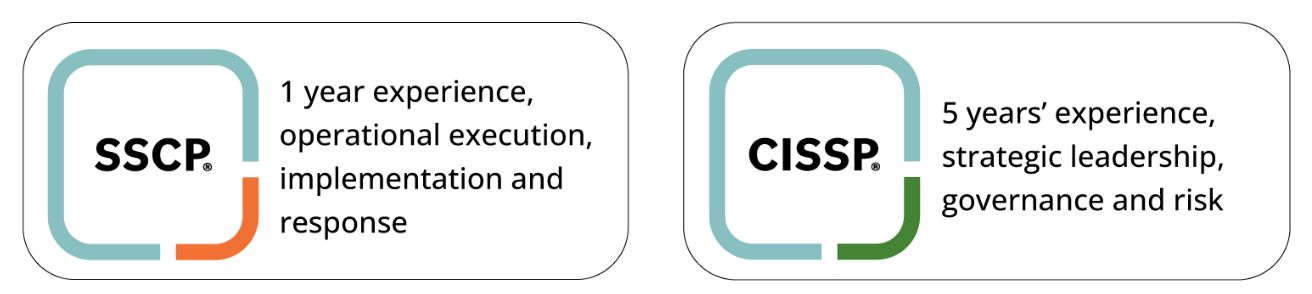
Both are complete career paths. Not sequential — complementary. SSCP for operational experts. CISSP for strategic leaders. Many professionals pursue SSCP and remain operational experts throughout their careers. Some later transition to CISSP when moving into leadership.
Strategy + Execution = Both Essential
|
Become an ISC2 Candidate.
|
*If you choose to renew after the first year, U.S. $50 due annually.
What is SSCP?
SSCP validates operational security capability — the proven ability to implement, monitor and administer IT infrastructure based on hands-on experience. Dive Deeper
Do I need experience before taking the exam?
No. You can pass the exam first and become an Associate of ISC2, then earn the required experience within two years.
How does the one-year experience requirement work?
One year cumulative, paid work experience in one or more SSCP domains. Part-time work counts (2 years at 50% = 1 year). A relevant bachelor's or master's degree can satisfy the requirement.
What if my experience spans multiple domains?
Perfect. SSCP values cross-domain operational capability. Document experience across any/all domains.
How much does SSCP cost?
Exam: U.S. $249. Annual maintenance fee: U.S. $135. First-year ISC2 Candidate membership: Free. Discover More
Does SSCP qualify for DoD 8140?
Yes. Intermediate operational work roles and Advanced for technical support specialists.
Can I earn both Security+ and SSCP?
Yes — and you should if working in DoD roles. They complement each other. Security+ = institutional knowledge. SSCP = operational capability. Discover How
Should I earn SSCP or CISSP?
Depends on your role and experience. SSCP = operational execution (1 year). CISSP = strategic leadership (5 years). Both are complete career paths. Choose based on your role, not just years of experience.
How do I maintain SSCP?
60 CPE credits every 3 years + annual U.S. $135 maintenance fee. Get the Details