Water infrastructure is increasingly central to national and economic security, supporting communities, industry, energy and emerging technologies such as artificial intelligence (AI). As an interactive ACTion Room session at ISC2 Security Congress 2026 explored, protecting it and ensuring resilience requires cybersecurity strategies that bridge IT and operational technology, reflect the varying capabilities of utilities, strengthen workforce skills and modernize legacy systems.
 Critical infrastructure such as water rarely commands the same public attention as more recognized technology-centric platforms, despite the interdependencies. Each of those priorities depend on reliable access to water. Communities need it for public health, industries for production and cooling, and datacenters require water and power to operate at scale. A disruption can quickly become a public safety, economic and national security issue.
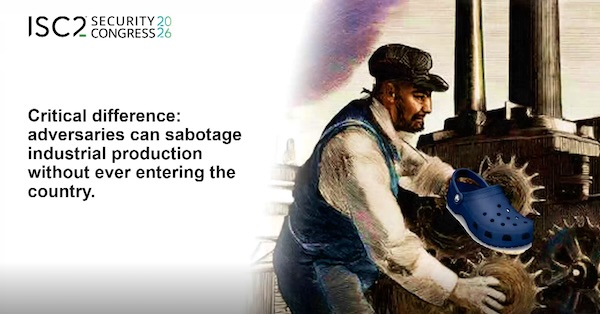
This makes water-sector cybersecurity more than a technical concern. Digital attacks on critical water infrastructure can have physical consequences from anywhere in the world. Building resilience requires policies and cybersecurity capabilities that address this cyber-physical risk while accounting for the different resources available to utilities of all sizes.
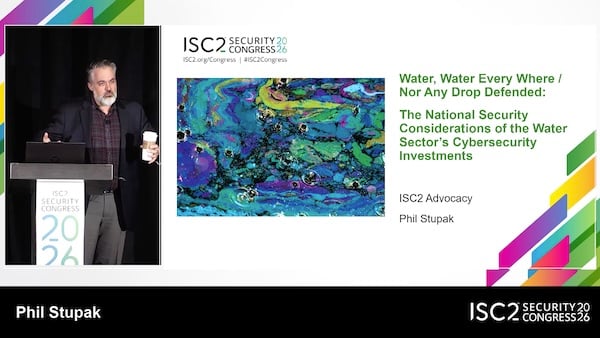
Philip Stupak, ISC2 Senior Director of Advocacy, led an ISC2 ACTion Room, Water Water Everywhere Nor Any Drop Defended, a new interactive session at ISC2 Security Congress this year, where audience discussions and workshopping generate valuable outcomes.
The Strategic Value of Water Is Rising
In the 20th century, steel and its supporting commodities were central to economic and national security. Today, AI and data-intensive infrastructure are becoming similarly strategic, relying not only on computing capacity but also on dependable power and water. That dependence makes water-system cybersecurity a broader resilience imperative. Cybersecurity incidents affecting treatment, pumping, telemetry or industrial control can disrupt water services and cascade across healthcare, government, manufacturing, food production and the digital economy.
Remote adversaries can also target operational technology, including supervisory control and data acquisition (SCADA) systems. Traditional IT security alone may not protect systems where digital commands control machinery, chemical treatment and the physical movement of water.
Cybersecurity Must Cross the IT-OT Divide
Water utilities combine IT and operational technology across business systems, sensors, pumps, treatment controls and SCADA networks. Security professionals therefore need to understand how cybersecurity risks can affect physical operations.
Cybersecurity preparation must extend beyond enterprise IT to industrial processes, safety constraints, legacy systems, vendor dependencies and remote access. Engineers and operators likewise need security practices suited to continuous, safety-critical operations.
A stronger cyber-physical focus can help practitioners apply established security principles to water systems, including utilities without dedicated operational technology security teams.
One Sector, Very Different Operating Realities
A central challenge is the diversity of the water sector. Cybersecurity responsibilities should scale with utility size, complexity and risk, rather than rely on a single staffing model.
Effective policy should set meaningful cybersecurity outcomes while allowing implementation to reflect each utility’s size and capacity. Requirements suitable for a large utility may overwhelm a small system with few employees, while standards designed for limited-capacity systems may underserve mature organizations with greater complexity and potential impact.
A Scaled Workforce Model Can Turn Guidance into Practice
Workforce policy should connect required capabilities to utility size and operational risk. Small systems may need a designated cyber coordinator, dependable IT administration, SCADA expertise, an operational technology integrator, compliance support and access to a qualified managed service provider. Those functions may be performed by a small number of people, but the responsibilities still need to be explicit.
Medium systems can begin separating responsibilities across IT and OT while establishing security analysis, incident-response coordination, network administration and cloud or telemetry expertise. Large systems generally require more specialized functions, including security leadership, risk management, operational technology security engineering, industrial networking, security operations, forensics, architecture and workforce training.
Certifications and professional development can help define and validate the knowledge needed at each level. The goal should not be to impose credentials as a substitute for experience. It should be to create clearer pathways for practitioners, utilities, service providers and policymakers to understand the capabilities required to protect increasingly connected water systems.
What a Water-Sector Transformation Could Require
A useful way to move beyond incremental thinking was to imagine that, by 2036, a major national effort with a generous budget successfully transformed water infrastructure cybersecurity.
Attendees were divided into groups representing four different themes:
- National Security and Resilience
- Workforce and Education
- Technology and Modernization
- Private Sector
Groups were prompted to talk about the policy, regulations and standards changes that occurred; what stakeholders drove them; the barriers had to be overcome; the role played by industry; and what ISC2 should advocate for today. After 20 minutes of lively discussions, groups presented their findings.
Water Resilience Depends on Collective Action
No single utility, profession or government agency can solve the challenge alone. Water operators understand the mission and physical process. Cybersecurity practitioners bring risk, architecture and incident-response expertise. Government can set priorities and create sustainable funding and accountability. Educators and certification bodies can develop the talent pipeline. Technology and service providers can make stronger security more accessible, especially for systems with limited internal capacity.
The strategic case is clear: water supports communities, industry and the infrastructure shaping the next era of economic competition. Protecting it requires cybersecurity investment that recognizes both the physical stakes and the sector’s diversity. The next step is to turn that shared understanding into a focused set of policies that utilities can implement and sustain.
Learn more about ISC2 Security Congress 2026 Sessions
Virtual and in-person attendees to Congress can see an on-demand replay of the session this article is based on as part of their existing access. On-demand access packages for Congress sessions will be available at a later date.