Consider this scenario: A deployment fails late on a Friday. A developer turns on debugging to figure out why. The resulting log contains something nobody intended to share: a token that unlocks access to another system. The problem started as routine troubleshooting. Now it’s an identity security incident.
That scenario anchored a live demonstration in the Security Congress session “The Invisible Workforce: How Non-Human Identities Are Breached and How to Defend and Govern Them.” Speakers Dhivya Balasubramanian and Vikas Gattu explored a familiar security problem hiding inside everyday automation: the non-human identities keeping systems running don’t always receive the same level of scrutiny as access given to humans.
The scale is striking. According to a 2025 study the presenters cited, some organizations have 144 non-human identities for every human one. Their message about managing this “invisible workforce” securely was practical: Understand what those identities can do, assign someone responsibility for them and prepare to recognize when legitimate access is being used by non-human entities for the wrong reasons.
What are Non-Human Identities?
First, what are non-human identities? They include service accounts, workload identities, build runners and AI agents. Non-human identities support essential work, from overnight database jobs to software deployments. But they don’t follow a human employee’s predictable journey through an organization. When someone leaves, for instance, established processes usually trigger access reviews and account removal.
A non-human service account that a person created, however, may keep running even after the human has left the company. Its credentials may remain valid, its permissions unchanged and its purpose increasingly unclear. See the danger therein? API keys and personal access tokens are among the credentials that allow software to authenticate and act.
Simply extending human identity controls isn’t enough. The security principles still apply, but the lifecycle, ownership and authentication mechanisms need different treatment.
To contain this invisible workforce securely, Balasubramanian suggests starting with three questions:
- What is acting?
- How does it prove its identity?
- What would happen if that credential were exposed?
One Non-Human Identity Compromise Can Travel
The presenters illustrated the stakes with the March 2025 compromise of tj-actions/changed-files, a GitHub Action used by more than 23,000 repositories.
A compromised bot token enabled malicious changes that caused affected workflows to print secrets into logs. The number of repositories using the action was not a count of confirmed breaches; instead, it demonstrated the potential reach of a trusted dependency.
The wider lesson was about connected access. One stolen credential can become an entry point into another system, where additional credentials or permissions expand the damage. In this case, as the presenters explained, the trail led back through another GitHub Action, reviewdog, which was itself breached with a token stolen from yet another action. It was a chain of trust, and every identity in it was a potential entry point.
Six Stages, One Chain
To make that progression easier to follow, the presenters organized their framework into six stages: discover, expose, acquire, exploit, escalate and persist.
For defenders, each stage offers opportunities to prevent exposure, spot suspicious behavior or contain an incident. Gattu’s live demonstration compared two exposed credentials. The first belonged to a build pipeline with narrowly defined, read-only permissions. An attacker could retrieve sensitive information, so the compromise still mattered. But attempts to gain administrative privileges failed.
The second belonged to an AI agent with broader authority. Its exposed credential allowed the attacker to obtain elevated access and establish persistence.
As Gattu explained, the difference wasn’t whether somebody made a mistake. Both credentials leaked. Instead, the difference was what the stolen access allowed, illustrating that least privilege access is much more than a policy requirement. Indeed it can determine whether an exposure stays limited or becomes a much larger incident.
The demo also brought up another crucial point: AI agents also raise an accountability question. If an agent uses a person’s personal access token, logs may attribute its actions to that person. Delegated, scoped access provides a clearer boundary between the user and the software acting on their behalf.
The presenters’ clearest warning was this call to action: do not let AI agents impersonate human or non-human identities. Many existing identities are already over-permissioned, and handing that access to an agent that can find ways to exploit it, intentionally or not, multiplies the attack surface.
Stronger Defense for Non-Human Identities: One Framework, Three Lenses
Balasubramanian and Gattu presented a framework for mapping the attack chain to three defensive responsibilities.
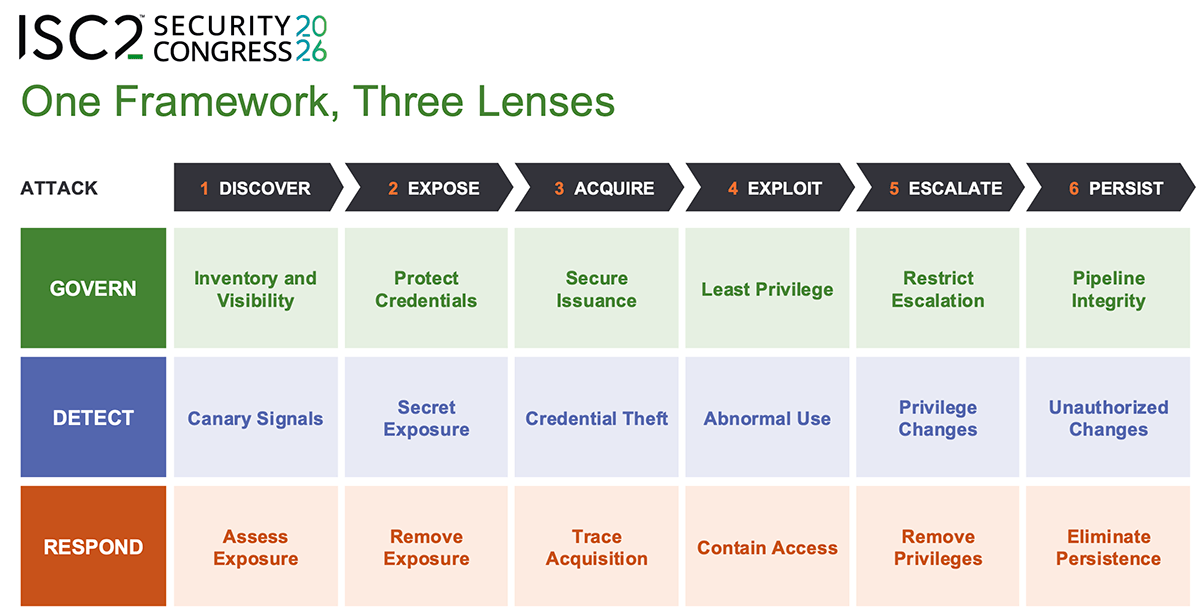
As Balasubramanian and Gattu explained, defenders can follow these steps across three lenses:
- Govern: Inventory non-human identities, document their purpose and assign a named owner. Protect credentials with a secrets manager and log masking. Where supported, replace long-lived secrets with short-lived credentials and workload identity federation. Restrict permissions and control who can create identities or change their access. The goal is to build safeguards into workflows rather than rely on someone remembering every rule during a rushed deployment.
- Detect: Look beyond successful authentication. A valid token doesn’t prove that its use is legitimate. Useful signals include unusual secret-store access, unexpected token creation, unfamiliar API activity, privilege changes and an agent operating outside its assigned task.Defenders can also set traps. Planting honey tokens, fake secrets that no legitimate process should use, gives analysts an early signal when someone is scanning repositories for credentials. Because the attacker must succeed at every stage of the chain while a defender needs to stop only one, even a single reliable signal matters.
- Respond: Don’t stop at rotating the first exposed credential. Investigate what it accessed, what permissions changed and whether additional identities or persistent access were created. Map dependencies to avoid unnecessary disruption, then verify that compromised access has actually been removed.
How to Get Started on Securing Your Invisible Workforce, Today
An organization-wide inventory can feel daunting. The presenters’ framework offers a manageable starting point: examine the non-human identities in your three most important pipelines. Give each an owner. Enable secret scanning and log masking. Review older tokens. Then build detections across the attack chain and test a compromised-identity response playbook.
Balasubramanian and Gattu left the audience with a pragmatic takeaway: The framework offers concrete steps cybersecurity teams can take without waiting for a perfect program. The invisible workforce is already doing important work. Making its access visible, and someone accountable for it, is where better protection begins, today.