As artificial intelligence transforms cybersecurity, professionals need more than awareness of its opportunities and risks. The new ISC2 AI Security Academy provides structured, practical learning to help cybersecurity professionals build the AI security skills relevant to their responsibilities, experience and career goals.
Today, ISC2 launches the AI Security Academy, a new professional development framework designed to help cybersecurity professionals build practical capabilities for securing an increasingly AI-enabled world.
Artificial intelligence (AI) is no longer confined to a single technology function or specialized team. It has implications for governance and compliance, risk management, security operations, software security, organizational strategy and other areas across the cybersecurity profession. The knowledge professionals need to address those implications varies significantly depending on the work they perform and the decisions they make.
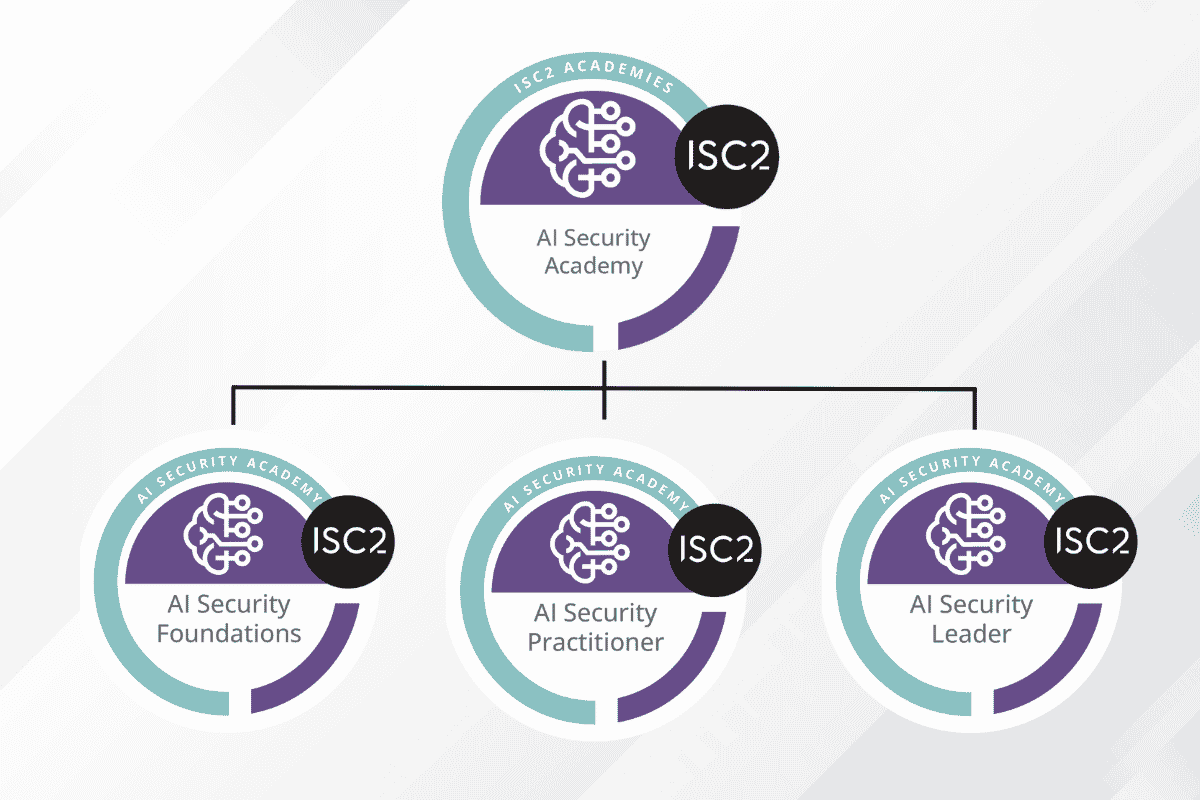
The AI Security Academy brings ISC2 certificates, courses and workshops together within a flexible framework that allows professionals to develop skills aligned to those differing responsibilities. Learning is organized across three progressive levels: AI Security Foundations, AI Security Practitioner and AI Security Leader.
A New Approach to Building AI Security Skills
AI is creating new opportunities across cybersecurity while also changing the knowledge and capabilities professionals need to manage security effectively.
“A professional establishing an organization’s AI strategy may encounter very different challenges than someone implementing AI-enabled security operations, assessing AI risk or securing AI-assisted software development,” said Stacy Mantzaris, Sr. Director, Professional Development at ISC2. “A single learning path cannot address every role, responsibility or use case in the same way. The AI Security Academy is designed around that reality.
Its progressive learning framework enables professionals to identify training relevant to their needs and deepen their knowledge as their responsibilities evolve.
“Rather than requiring every learner to follow a mandatory sequence, professionals can select a starting point aligned with their existing knowledge, role and development goals,” said Jon Duggan, Associate Director, Learning Experience at ISC2. “That flexibility supports a shared understanding of AI security while allowing learners to go deeper based on their professional responsibilities and the decisions they’re accountable for.”
Three Levels for Different AI Security Needs
The ISC2 AI Security Academy organizes professional development into three levels that reflect different learning needs and applications.
AI Security Foundations establishes a common baseline in AI security concepts and the strategy and governance considerations surrounding them. Existing opportunities within Foundations include the Building AI Strategy Certificate and eligible Securing AI workshops. Eligible learning completed previously can also count toward Academy progress.
AI Security Practitioner moves from foundational concepts toward applied capabilities. Practitioner learning is organized across four areas: Governance & Compliance, Risk Management, Security Operations and Software Security. These pathways explore subjects ranging from AI governance architecture, regulatory intelligence and data governance to AI-assisted threat detection, incident response, penetration testing and secure software development.
AI Security Leader supports advanced application and decision-making through workshops focused on Organizational Management; Governance, Risk and Compliance; and Software Security.
Together, the levels create structure without imposing a one-size-fits-all path.
Start Where Your AI Security Responsibilities Begin
“Progressive learning doesn’t mean every professional needs to begin at the same place,” Duggan said. “The goal is to meet learners where they are, helping them build on the capabilities they already have while identifying the AI security knowledge that can help them address what comes next.”
Someone building foundational AI knowledge may start with AI Security Foundations. A professional responsible for security operations or risk management may identify Practitioner learning that aligns more directly with current responsibilities. Experienced cybersecurity leaders may need advanced development centered on organizational strategy, governance or secure implementation.
The Academy is designed to accommodate those different starting points rather than requiring a mandatory Foundations-to-Practitioner-to-Leader sequence.
It also recognizes learning already completed. Professionals who previously completed eligible Academy components can receive credit toward the corresponding Academy progress rather than repeat that learning. For example, eligible prior completion within the Foundations structure counts toward the AI Security Foundations badge.
“This approach gives cybersecurity professionals a way to build on the capabilities they already have while identifying the AI security knowledge that can help them address what comes next,” said Duggan.
Turn AI Security Knowledge Into Practical Capability
The Academy's structure reflects the breadth of ways AI now intersects with cybersecurity practice. At the Practitioner level, for example, learning extends across four distinct areas.
- Governance & Compliance addresses subjects such as AI governance architecture, policy mapping, regulatory change and AI data governance.
- Risk Management includes AI-driven data discovery, enterprise risk aggregation, controls monitoring, bias and model assurance, and AI risk assessment.
- Security Operations focuses on areas including AI-driven penetration testing, AI-augmented incident response, AI-assisted threat detection and network analysis.
- Software Security incorporates topics such as DevSecOps, SAST and DAST, AI-powered code completion and repair, threat-to-requirement mapping and secure software architecture with AI.
That breadth matters because developing AI security capability is not simply about understanding how AI works. Security professionals increasingly need to understand how AI changes the work they already do and how to apply sound cybersecurity principles as technologies, risks and regulations evolve.
For organizations, developing those capabilities across different roles can also help establish common AI security language while supporting deeper knowledge among the practitioners and leaders responsible for implementing and overseeing secure AI use.
Start Learning Now as the AI Security Academy Grows
Today's launch introduces the AI Security Academy framework and learning experience, but it does not mark the release of every course and workshop planned for the Academy. Some learning is available now, while additional components will be introduced in phases. Professionals can begin with currently available learning and register for updates about forthcoming opportunities relevant to their interests. As additional components launch, learners can return to continue building toward the badges and recognition associated with their chosen Academy pathways.
Existing components available at launch are offered individually. Bundled learning options are planned only after all components required for them are available, providing purchasing convenience without changing the Academy's flexible learning structure.
This phased approach also enables the Academy to continue expanding as technology, risk, regulation and the role of AI in cybersecurity evolve.
Expanding the ISC2 AI Security Learning Journey
The AI Security Academy is one part of ISC2's broader approach to supporting the cybersecurity profession through the accelerating adoption of artificial intelligence. That approach encompasses AI knowledge across existing ISC2 certifications, professional development through the AI Security Academy and a forthcoming ISC2 AI Security Certification.
The Academy provides a practical professional development pathway within that larger ecosystem, allowing cybersecurity professionals to build capabilities relevant to their work today and continue developing them as their roles and the AI security landscape evolve.
Explore the ISC2 AI Security Academy to identify learning aligned with your responsibilities, start available training and register for updates about forthcoming Academy offerings.