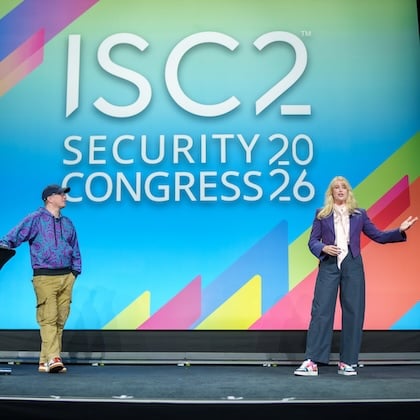
Cybersecurity professionals must grapple with the twin threats of AI and quantum computing if they want to confound current risks and build the long-term future they want, Jaya Baloo told attendees at ISC2 Security Congress.
In her keynote session, COO and CISO at AISLE Cybersecurity, Jaya Baloo kicked off by acknowledging that for cybersecurity professionals, life is already “kind of rough. Last week was not an easy week,” as CISOs had had to grapple with the PHP crisis, a critical GitLab vulnerability and multiple other cyber security crises.
This begs the question, “What is our place when we look at what our industry needs to do to step up to meet the challenges that these revolutions are actually beginning?” She added, “I think we can safely say that things are generally aflame”.
She went on to discuss some of the potential problems AI presents for cybersecurity.

First, she asked whether for a sector that loves benchmarks, if “The next necessary benchmark was a felony benchmark,” given some of the behaviors seen in AI models and their potential for aiding human attackers.
On top of this were “misalignment issues”, AI doomism and, arguably over-inflated, fears about AI driven botnets that were being “parlayed to regulators, to folks that do foreign policy”.
The Consequences of Actions and Inaction
Cybersecurity professionals “will inevitably face the consequences if we're not really at the table having these discussions, where we can bring some knowledge about how botnets work.” Otherwise, “We're going to be on the menu of the decision that subsequently happens”.
More directly, Baloo highlighted that while identity issues have long been the key method for attackers to access networks, the tables have now turned. Vulnerability exploitation is in the ascendent. Meanwhile, the time to exploitation has shrunk from years to months and would likely be counted in minutes by 2028.
“Where I also worry is the fact that as we do this, as we use AI for all of the different things, we seem to have forgotten fundamental principles around how we embed different technologies into our networks,” she said.
“We seem to forget that we have capabilities, enormous capabilities, but we don't actually now distinguish equally amongst the authority that those capabilities can have.” She added, “The final thing that I really want to urge you to think about, as CISOs and security people, is thinking about AI as this insider threat”.
Third Party Influence and Impact
Companies are importing “something with its own sense of agency into your network, and unless we actually really carefully control for different forms of misalignment, it will actually manifest as this actual attack surface,” Baloo said.
Models could be manipulated and infected, Baloo added. “We need to have a better taxonomy … of how we address these kinds of failures”.
Worryingly, cybersecurity principles were not being applied from the top, she said. In the Hugging Face Open AI attack, there was actually “no forensic evaluation from the OpenAI side”.
“These are things that we already know how to do in cybersecurity. We need to make sure that they happen in AI as well”.
What made this even more worrying, she said, was that AI could be embodied in physical ways, such as quadrupeds or humanoid robots. She cited a raft of security concerns about systems from China’s Unitree’s Robotics, ranging from takeovers via Bluetooth Low Energy and remote code execution, to a pre-installed back door.
These were devices that supposedly were able to do kung foo, she said, if not fold laundry. “So again, before you go ahead and get, which is inevitable, the human or physical or whatever manifestation of AI in its many forms, I really want us to have again the ability to do what we always do, which is vendor risk review, third-party risk management”.
Quantum Considerations
But AI doesn’t exist in a vacuum and the rapid development of quantum computing threatens to amplify the problems around AI, Baloo said, presenting cybersecurity problems in their own right.
“We tend to focus and zoom in on quantum computing. But really, quantum is so much more,” she said.
“It's also communication and building entire like new internet-like communications using quantum technologies. It's also quantum simulation. It's also building new sensors and clocks using quantum sensing and metrology”.
Critically, Baloo explained, it’s a threat to the algorithms underpinning encryption.
“This is why it becomes so compelling. We also have this problem that everything that we've ever transmitted that was considered cryptographically secure suffers from this harvest now decrypt later problem.”
Current forecasts for the point at which quantum computers are able to crack standard encryption – the so-called “Q day” – are looking at 2029/30, she said.
Baloo continued, “I don't want you to think that way. I want you to think much earlier about that transition,” before examining quantum safe algorithms and post quantum tools and messaging platforms. “This again requires the power of our entire community to come together if we genuinely want to make this secure”.
“I think we have a choice ultimately, with quantum, with AI. We choose what our next big risk is going to be. [If] we don't think about how we do it now, we're going to pay for it later”.
And this includes thinking about the entire tech supply chain. With the US and China dominating swathes of tech, “We need to fight for this ability to have every layer of this piece be fully sovereign”.
This is more than just a question of frontier LLMs or open-weight models. “It means the chips, the fab in order to produce it. It means that entire ecosystem and that supply chain, we need to know how we can trust it and potentially control it.”
Evolving the Skill Set
At the end of the session, Baloo noted that cybersecurity people had to be better communicators, both with the organization and with their peers, in AI and quantum.
“It feels like with the adoption of AI, we forgot all of the stuff that we already knew. Like, do you guys all have an asset inventory for all of the AI systems you use? I think we have this phenomenon happening now of shadow AI and that is a genuine problem.” Baloo added, “I still think that we have a place to say when we come to adopt any new technology, whether it's AI or robotics or some sort of industrial robotics for manufacturing, we still think about how do we always treat this from a security perspective and not let go”.
This mean being “incredibly tenacious about asset and inventory management, third-party risk management, understanding the supply chain”.
The benign vision of a few years ago, with researchers sharing technology and information for the common good, might seem farther away now.
But, as Baloo said concluding her speech, “This is your future, and if you don't take an active part in it, it definitely will not happen”.
Learn more about ISC2 Security Congress 2026 Sessions
Virtual Congress attendees can watch an on-demand replay of this keynote as part of their existing access. On-demand access packages for Congress sessions will be available post-event.