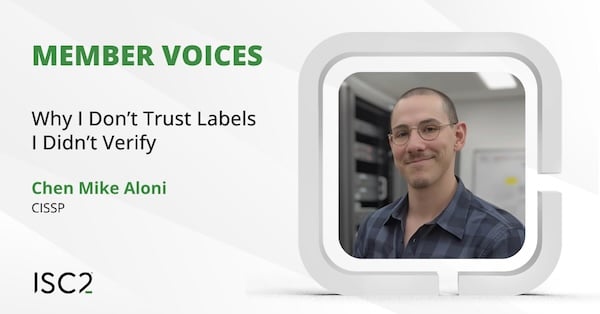
Army veteran Chen Mike Aloni, CISSP, believes that the most dangerous failures he’s lived through weren’t technical but taxonomic: someone applied the wrong label, everyone downstream inherited it and the response marched confidently in the wrong direction. The label is the thing we verify least and trust most – and that can be costly.
 Disclaimer: The views and opinions expressed in this article belong solely to the author and do not necessarily reflect those of ISC2.
I treat my own cognitive bias as the root vulnerability. If I had to file it, I would call it CVE-0000-000001: Human Bias, ancestor of every other flaw in the stack. I can’t patch the bias of the analyst beside me, or of the executive above me. But I can patch my own. So, before I accept any label I didn’t produce, I run the same short interrogation on myself: Who set this label and what did they actually see? What am I inheriting and what have I verified? What would prove this label wrong? Am I agreeing with the data, or with the rank of the person who said it?
Those four questions are the only patch I have found. The three stories below are what happened to me when no one asked them.
Five Hours Defending a Dead Machine
The first time it cost me was a winter weekend, on call for a client whose security and network operations I helped run. An alert fired: the monitoring platform was missing half its log sources. Procedure said handle it alone and brief management only after the holiday. Rather than wake my family I carried my laptop to the freezing porch and sat in the cold for five hours, reconnecting sources, clearing a stuffed disk and reviving containers that had quietly died. I closed it out near half past five in the morning.
All that night I trusted one thing completely: the system the playbook named as authoritative. When I reported in at nine the next morning, the truth landed. That platform was a zombie, half decommissioned, missing sources, already being replaced by an undocumented successor. Neither my team nor the operations center knew. The heartbeat alarms had fired precisely because the box was dying. I’d spent five freezing hours defending a corpse, because I trusted a label nobody had updated. The technology hadn’t failed me; metadata had.
What I took from that night was a lesson about judgment. Back then, I followed procedure to the letter, because the client’s response program was immature and I hadn’t yet built one of my own. Today, when I see gaps that large in an environment still finding its feet, I weigh procedure against the maturity behind it – and I wake the manager at three in the morning if I need to.
Clean Logs on a Full Disk
The second time, the wrong label was set by rank. An endpoint the EDR reported as offline was, in reality, throwing heavy traffic and creating files in bulk. The first triage was mine; I took the machine apart by hand and found that someone had installed a media application that had dropped a crypto miner. The vendor insisted the endpoint was clean, because the logs were clean. But the logs were clean for one reason: the disk was completely full, so nothing new could be written. Clean logs weren’t evidence of safety at all; they were merely evidence of a full disk.
I escalated through the vendor’s support and asked to own remediation and root cause analysis. A senior executive looked at it, called it ‘nothing’, labeled it a low-level cleanup, and took me off the case. The classification was set by seniority, not by the evidence in front of us.
Then, nearly a year later, ransomware hit one of the servers. An external response firm reconstructed the chain: that same endpoint, the security logs, the traffic, the malicious application and a set of weak permissions that had allowed quiet lateral movement.
I take no satisfaction in this and have spent more time on my own failure than anyone else’s. What I should have done was refuse to let a senior ‘nothing’ close an investigation I couldn’t close based on the data.
A label from authority is still only a claim. I had the evidence, but I let rank outrank it. What I took from that year was simpler and harder than any procedure: I am in charge of my own finger on the trigger and I won’t cede that responsibility to a job title again.
The $5 Million Tag
The third time, the label was a single phrase inherited on a ticket: low priority. When I joined a software company in a hands-on security role, a recurring ticket reached my queue for the first time.
It carried two tags everyone trusted: “low priority” and “known recurring issue.” A service crashed on a cycle and every cycle someone applied a band-aid and closed it. The ticketing system did not aggregate the history, but every team knew it was the same failure, again and again. For years no one had run a root cause analysis, because the label said there was no point.
I ignored the tag and ran the analysis nobody had bothered to run. The ground truth was horrific: a conservative estimate was that the “minor recurring glitch” was burning roughly $60,000 a month, just in the salaries of idle engineers who couldn’t work while the development lifecycle was frozen. It didn’t account for project slippage or technical debt.
Across the roughly eight years this had been going on before I arrived, the ‘loss’ was well past $5 million. When I presented it, finance and management confirmed the figure. (The fix, it turned out, was small: a short script, on a schedule, that removed the root cause for good.)
But the money is not my point. My point is that a stale “known issue” tag had quietly normalized a catastrophic, recurring loss, and it survived because no one re-derived the label. I caught it only because I was new enough to have not inherited the complacency.
What I Actually Do and Where I Stop
I’m certainly not suggesting that everyone else is biased and that somehow I’m the exception; I’m as anchored, deferential to authority and as quick to trust a confident machine as anyone here. Perhaps the one difference is life experience, which means I treat every label I inherit as a hypothesis, not a fact; and that I therefore run those four questions before I act, going back to the raw evidence to ask what the data actually proves.
But nor can I ‘pretend away’ the limit: re-deriving every label does not scale. At real alert volume, the team that verifies everything verifies nothing in time. So, I don’t check every label; I draw a line.
I decide in advance which labels I will never accept on trust – those whose blast radius is large, or whose errors surface slowly – and I re-derive those by hand, no matter who set them. The rest I accept on trust, on purpose, knowing some will be wrong.
That choice has a cost. It makes me slower and, yes, it sometimes costs me trust, because I’m the one reopening a settled ticket or questioning a senior call. I weigh that against resilience and risk. I don’t refuse every shortcut; I choose the corners I will never cut, and I cut the others on purpose.
In Closing
I no longer believe a label is the truth. It’s someone’s claim about the truth, frozen at a moment that has probably passed. And I would rather trust the evidence under it than the label on top. But I want to be honest about the limit: CVE-0000-000001 has no patch. I still anchor and I still defer to the confident voice in the room. I still get fooled by a clean log.
My four questions are not a cure but a fight I start over every day. Some days I lose. I keep the rule even when it slows me down: lead with certainty, audit with doubt. The certainty is easy. The doubt is the part I have to keep choosing.
Chen Mike Aloni, CISSP, has six years of experience across regulated and high-assurance environments. He has built a cybersecurity program from the ground up, recruiting and training a team of engineers and reporting to executive management. He is currently working toward senior, generalist security leadership.