Expanding on the initial document released in April, the updated guide includes an updated focus on Certified in Cybersecurity, showing how the foundational certification maps to today’s AI security work tasks and needs.
Artificial intelligence (AI) is reshaping the daily work of cybersecurity professionals, requiring them to demonstrate AI fluency and competence in areas such as AI governance, model security, data integrity, prompt engineering, AI risk management and the security of AI-enabled systems. As cybercriminals increasingly use AI to enhance phishing, social engineering and other attacks, practitioners need to show they are equipped to apply their analytical, critical thinking and oversight capabilities to AI-centric situations.
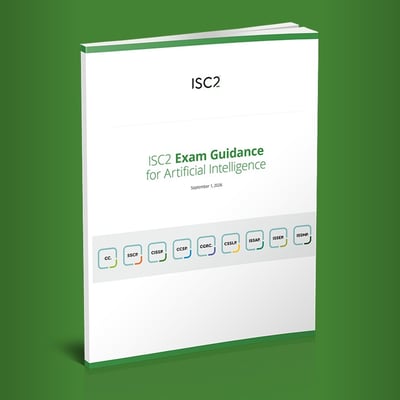
The ISC2 Exam Guidance for Artificial Intelligence provides an overview of how AI topics are incorporated into all nine ISC2 certification exams. Mapping AI-related content across more than 50 cybersecurity domains and 200 tasks, the document shows how ISC2’s continuous review and maintenance process keeps its certifications aligned with emerging technologies, helping certified professionals develop the knowledge and skills needed to secure organizations in an increasingly AI-driven world. The latest version has been released, which includes an extensive addition showing how the foundational Certified in Cybersecurity (CC) certification maps to AI roles, tasks and the evolving cybersecurity threat landscape.
Focus on Certified in Cybersecurity (CC)
Updated as of September 1, 2026, the CC certification incorporates foundational AI concepts across all five exam domains, ensuring entry-level cybersecurity professionals understand the security implications of AI technologies. Candidates should understand how AI affects security principles, governance, identity and access management, networking, cloud security, and security operations. The exam emphasizes securing AI systems and data, managing AI-related risks, supporting governance and compliance requirements, and recognizing AI-enhanced threats such as advanced phishing attacks. It also explores how AI strengthens security through improved monitoring, authentication, incident response, and threat detection. This integration helps prepare new practitioners to work confidently in increasingly AI-driven environments.
Reshaping the Skills Requirements of Cybersecurity Professionals
For cybersecurity professionals, the ISC2 Exam Guidance for Artificial Intelligence guide serves as a roadmap for professional development. The guide demonstrates how AI considerations are becoming embedded across a broad range of cybersecurity responsibilities and domains.
It helps individuals understand where AI is influencing existing cybersecurity practices, which skills are becoming increasingly important, and how their roles may evolve as AI becomes more deeply integrated into security operations and business processes. This is particularly valuable at a time when many organizations are adopting AI-powered security technologies and cybersecurity professionals are prioritizing AI-related learning and skills development.
By mapping AI concepts to established exam domains and tasks, the guide shows how certification content reflects real-world changes in technology and cybersecurity practice. This helps certification holders, employers and hiring managers understand that the ISC2 credentials that members hold and are working towards continue to align with the evolving demands of the profession.
Find Out MoreIn addition to the certifications, ISC2 integrates AI throughout its continuing education resources. These include the AI security certificate, courses, research and peer-developed articles sharing best practices. See the Exam Guidance for Artificial Intelligence to learn more. |