As organizations accelerate artificial intelligence (AI) adoption, cybersecurity professionals increasingly recognize the need for clear governance, accountability and security standards. Results from an ISC2 community poll on LinkedIn have revealed where practitioners believe the profession should focus as AI security evolves and why community involvement is critical to shaping future certification standards.
 AI is transforming cybersecurity at an unprecedented pace. From accelerating threat detection and incident response to enabling new forms of automation, AI is already reshaping the way organizations defend themselves and manage cyber risk. Yet as adoption grows, so too does the need for cybersecurity professionals to define what secure and responsible AI implementation looks like in practice.
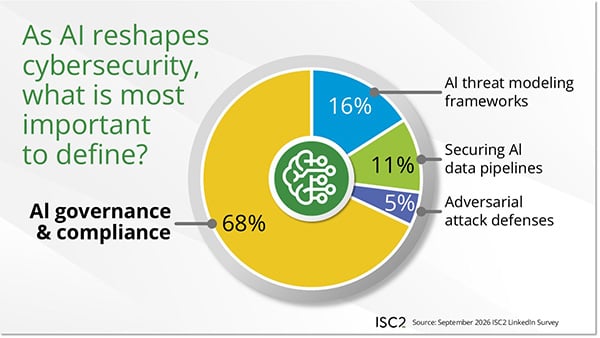
As part of the work on the development of an AI security certification, ISC2 recently asked cybersecurity professionals to share their views on one critical question: As AI reshapes cybersecurity, what is most important to define?
More than 500 professionals participated in the poll, offering valuable insight into where the cybersecurity community believes attention should be focused. While respondents identified several important technical priorities, one theme clearly stood out. Nearly seven in ten participants (68%) selected AI governance and compliance as the most important area requiring definition as AI security continues to evolve.
AI Extending Far Beyond Technical Needs
The result reflects a growing recognition that organizations need more than technical controls to manage AI-related risks. Governance frameworks, accountability structures, regulatory compliance requirements and ethical considerations are rapidly becoming central to successful AI adoption. As organizations deploy AI-powered systems across business-critical functions, security professionals are increasingly being asked to balance innovation with risk management, transparency and responsible use.
The poll also highlighted the continued importance of foundational security practices. Some 16% of respondents identified AI threat modelling frameworks as their top priority, pointing to the need for structured approaches to identifying and mitigating risks unique to AI systems. As AI introduces new attack surfaces and dependencies, organizations require methodologies capable of assessing threats across the entire AI lifecycle.
Meanwhile, 11% of participants prioritized securing AI data pipelines. Data forms the foundation of all AI systems, making its protection essential. Issues such as data integrity, privacy, provenance and access control remain critical considerations for organizations developing or relying on AI-enabled technologies.
A smaller but still significant proportion of respondents (5%) highlighted adversarial attack defenses as their most important area to define. While this received the lowest share of votes, it remains an important and topical concern as attackers continue exploring techniques designed to manipulate, evade or poison AI models.
Taken together, the results demonstrate the breadth of challenges facing cybersecurity professionals as AI adoption accelerates. Technical safeguards, secure development practices and specialized attack defenses all play important roles. However, the poll suggests that many practitioners view governance as the foundation that enables organizations to address these challenges consistently and responsibly.
Defining the Path for an AI Security Certification
These insights reinforce the importance of developing a certification that reflects real-world AI security responsibilities and professional practice. Defining the knowledge, skills and abilities needed to securely design, deploy, govern and manage AI systems requires input from across the cybersecurity community.
That is why ISC2 is inviting cybersecurity professionals to participate in the AI security certification development process. Volunteers will have the opportunity to help shape certification content and ensure it reflects the realities practitioners face today and will face in the future.
If you want to join more than 7,500 of your industry peers and contribute to the development of the profession and help establish the standard for AI security expertise, register now to participate. Your experience and perspective can help ensure the certification meets the needs of organizations and professionals navigating the evolving intersection of AI and cybersecurity.