April is Neurodiversity Awareness and Celebration Month and to mark the occasion, we took a closer look at the experiences of neurodivergent professionals in cybersecurity to better understand how workplaces can be more inclusive and supportive.
As cybersecurity teams evolve, neurodiversity offers an important lens to see how people experience their work, including engagement, wellbeing and career outlook. Identifying and recognizing these differences can help organizations build more supportive and resilient workplace cultures.
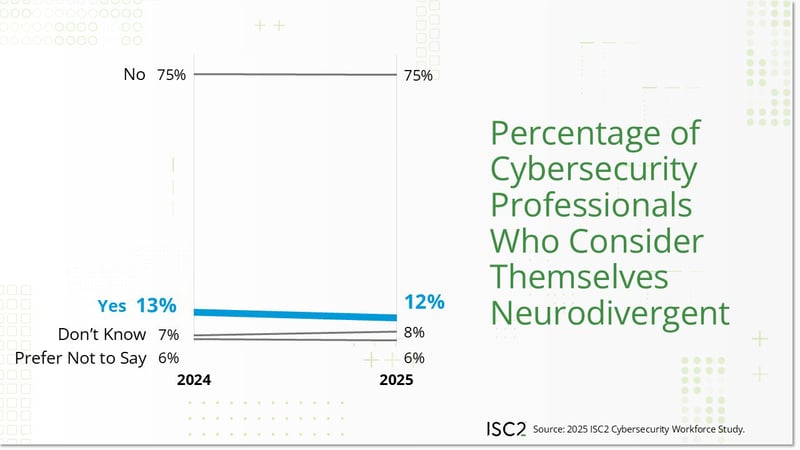
To explore these insights, we examined responses from the most recent ISC2 Cybersecurity Workforce Study. Of the 16,029 respondents worldwide, 1,852 identified as neurodivergent, representing 12% of the total sample.
The findings that follow highlight how neurodivergent professionals are represented across cybersecurity roles, how they experience workplace satisfaction and support and how they view their future in the profession.
Representation and Career Journeys in Cybersecurity
Neurodivergent participants are represented across organizations of different sizes and at various career stages, with some notable differences compared to the broader workforce.
Compared to the overall respondent base, those who identified as neurodivergent are slightly more likely to work in small organizations (1–99 employees), with 17% reporting employment in organizations of this size, compared with 15% of the overall respondent base.
When it comes to entry pathways into the field, IT remains the most common route for both neurodivergent and the overall respondent base, with similar proportions transitioning from IT roles (54% vs. 56%, respectively). Smaller differences appear across other entry pathways, with neurodivergent respondents somewhat more likely to report entering cybersecurity through independent exploration prior to their first role (6% vs. 4% overall) or through military service (5% vs. 3% overall).
Differences also emerge when looking at role level and management representation. Across levels, neurodivergent professionals are more likely to hold non‑managerial mid‑ or advanced‑level roles (44% vs. 39% overall) and are less likely to be in management roles (45% of neurodivergent respondents hold a manager-level position or higher, compared to 51% overall).
Job Satisfaction: Improving but Room to Grow
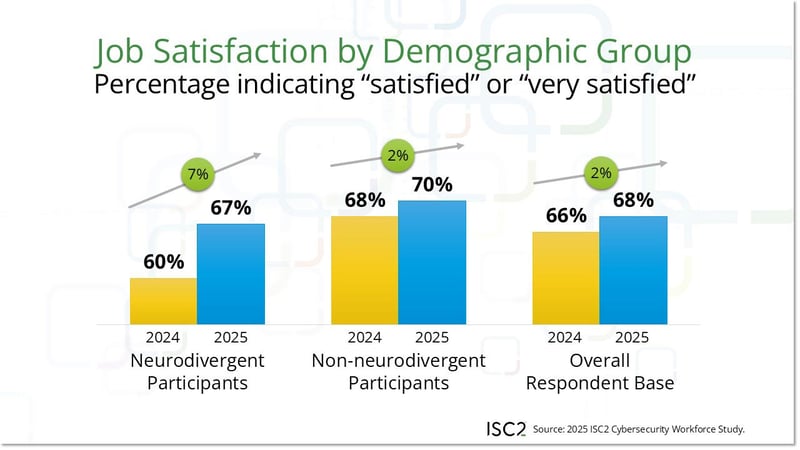
Job satisfaction among neurodivergent participants remains lower than among other respondents, though it has improved over time.
67% of neurodivergent respondents report being satisfied with their job, which saw a 7-percentage-point increase compared to 2024. However, it remains significantly lower compared to participants who don’t identify as neurodivergent (70% satisfied) but is on par with the overall survey average (68%).
Feeling Valued Is Closely Linked to Satisfaction
Differences in job satisfaction align closely with how valued respondents feel at work.
Among neurodivergent participants, 64% agree that they feel appreciated and valued at work. This is significantly lower compared to 71% of participants who don’t identify as neurodivergent, as well as 69% of the overall respondent base. Even so, engagement with work itself remains high: 79% of neurodivergent respondents report feeling passionate about what they do, on par with non‑neurodivergent respondents (81%) and overall (80%).
Across the workforce, feeling valued is strongly associated with job satisfaction. Among neurodivergent participants who did not feel valued, job satisfaction was 28%. Among those who strongly agreed that they felt valued, job satisfaction rose to 87%, a difference of 59 percentage points.
Comparable patterns appear elsewhere. Among non‑neurodivergent respondents, satisfaction increases by 46 percentage points when respondents feel valued (39% to 85%). Across the overall respondent base, satisfaction rises by 50 percentage points, from 34% to 84%.
What Gets in the Way of Satisfaction
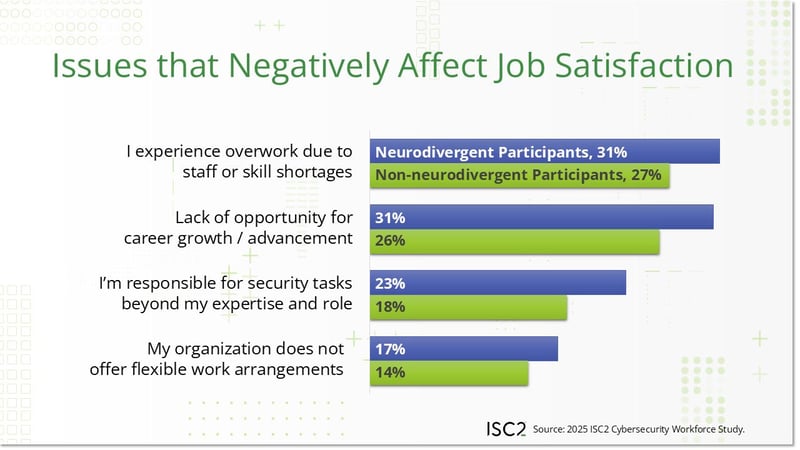
Neurodivergent respondents are more likely to identify certain workplace conditions as negatively impacting job satisfaction when compared to those who don’t identify as neurodivergent. These include lack of opportunity for career growth/advancement (31% vs. 26%, respectively), covering security responsibilities outside of their role or expertise (23% vs. 18%), overwork due to staff or skill shortages (31% vs. 27%), and lack of flexible work arrangements (17% vs. 14%).
Alternatively, when asked what their organizations are doing to make them feel engaged, neurodivergent respondents were more likely to cite offering flexible work arrangements, such as remote/hybrid settings and flexible schedules (43%) than those who don’t identify as neurodivergent (38%), as well as the overall respondent base (38%).
Looking Ahead: Staying in Cybersecurity
Short‑term intent to remain with current organizations is similar across groups, as 74% of neurodivergent participants report being likely to stay with their organization over the next 12 months, compared with 76% of those who don’t identify as neurodivergent, and 75% overall.
Differences emerge over the long-term horizon: 64% of neurodivergent participants expect to stay with their organization for the next two years, compared with 67% of those who don’t identify as neurodivergent, and 66% of the overall respondent base.
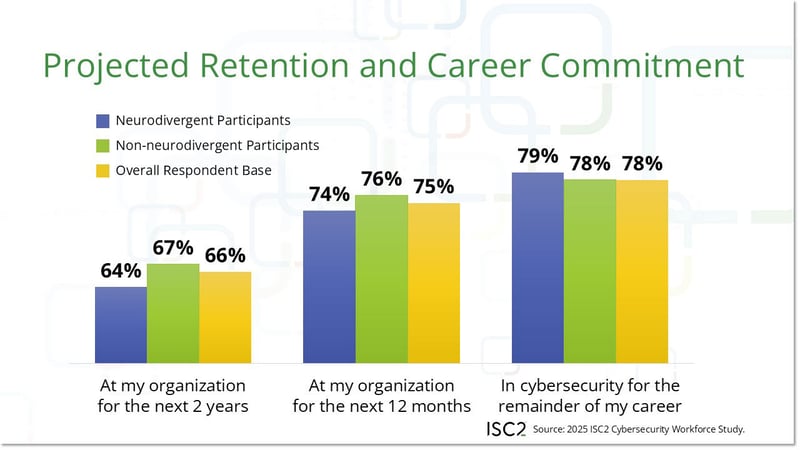
Despite this, confidence in cybersecurity as a long‑term career remains strong, as 79% of neurodivergent participants say they are likely to remain in the field for the remainder of their careers, on par with those who don’t identify as neurodivergent (78%) and the overall respondent base (78%).
The Pace of Cybersecurity Work and Career Longevity
Respondents across the cybersecurity workforce largely remain confident in the profession itself, even as many navigate the demands of a fast‑moving field. A great majority of neurodivergent participants (80%) report confidence that the cybersecurity profession will remain strong, closely aligned with those who don’t identify as neurodivergent (82%) and the overall respondent base (81%).
At the same time, neurodivergent participants are more likely to report feeling uncertain about the longevity of their individual careers, with 32% agreeing with this sentiment, compared with 27% of non-neurodivergent respondents and 28% of respondents overall.
Signs of overwork and pressure related to pace are evident across the cybersecurity workforce. Nearly half of all respondents (48% overall) report feeling exhausted by the need to stay current on emerging threats and technologies. Neurodivergent respondents are more likely to report this exhaustion (53%), compared with 46% of non‑neurodivergent respondents.
These findings suggest that while confidence in cybersecurity as a profession remains strong across the workforce, neurodivergent professionals are more likely to report pressures related to pace, workload and the outlook of their own careers.
What Support Systems Matter Most
When asked which organizational support systems are most important to their success, neurodivergent respondents placed greater emphasis on supports tied to flexibility and accessibility.
Nearly four in ten neurodivergent participants (38%) identified support for caregivers or flexible work arrangements as most important, compared with 33% of those who don’t identify as neurodivergent.
Neurodivergent respondents were also more likely to select scholarships or financial assistance (28% vs. 25% non‑neurodivergent) and career‑switching pathways for non‑traditional entrants (22% vs. 19%), highlighting the importance of diverse entry routes and career flexibility.
Key Takeaways
The findings highlight areas of strength and opportunity when it comes to supporting neurodivergent professionals in the cybersecurity workforce.
Neurodivergent participants show strong confidence in cybersecurity as a profession, with optimism about the field’s future closely aligned with the broader workforce. At the same time, they are more likely to report higher levels of exhaustion and lower confidence in the longevity of their individual careers, even while maintaining high levels of passion for their work.
Recommendations
1. Flexibility Matters
Neurodivergent participants place greater emphasis on flexible work arrangements and caregiver support, reinforcing the importance of work models that are adaptable and that support wellbeing.
2. Feeling Valued is Closely Tied to Satisfaction
Feeling appreciated and valued is strongly associated with job satisfaction across the workforce, with particularly large differences among neurodivergent participants, highlighting the impact of inclusive cultures and visible recognition.
3. Accessible Pathways Support Success
Greater emphasis on scholarships, financial assistance, and non‑traditional entry or transition pathways reflects the value of reducing barriers to entry and progression within the field.
4. Wellbeing and Workload Matter
As cybersecurity continues to evolve at a rapid pace, many respondents report fatigue related to constant change, highlighting the need to keep workload and wellbeing in mind, even amid innovation and growth.