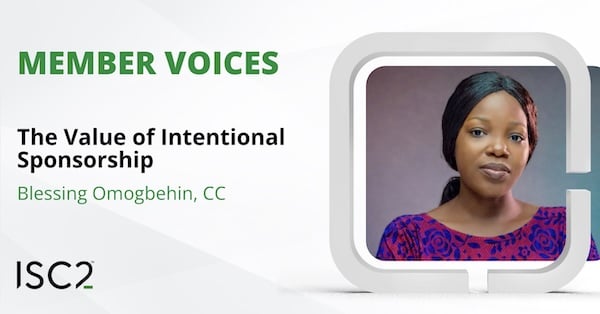
In a field as broad and fast-moving as cybersecurity, the identification and presence of clear career pathways matter. Blessing Omogbehin, CC, sees this as even more critical in regions like Africa, where access can be a real limitation and the cost of certifications, training and exams can be overwhelming. She believes that scholarships, flexible certification pathways, employer-sponsored training and community-led support could bridge that gap.
 Disclaimer: The views and opinions expressed in this article belong solely to the author and do not necessarily reflect those of ISC2.
I was never interested in just how systems worked. I wanted to understand how to protect them, how to keep data safe in a world where everything is digital and vulnerable. So, I started learning cybersecurity on my own, long before I discovered bootcamps or communities that later helped sharpen my skills. When it was time to pursue my master’s degree in computer science, choosing the cybersecurity path felt natural. I dove deep into securing cloud data from unauthorized access and explored the powerful combination of artificial intelligence (AI) and blockchain for anomaly detection in cloud environments.
I just want to see organizations feel safe, confident and protected, instead of waking up to headlines. I love the idea that my skills can actually protect people, systems and opportunities. There’s always something new to learn and the quiet fulfillment of knowing that even when the work is unseen, it matters.
Technical Tasks are Not the Obstacle
The technical difficulty of the work has never surprised me. But what has surprised me is the quiet assumption that women in cybersecurity are there to support, coordinate, or explain, rather than to design, analyze, or lead. My presence in the room was often questioned before my expertise was considered. I had to demonstrate depth many times before becoming trusted - even with years of experience. In those moments when I felt like I was having to prove my competence, the pressure isn’t just to do your job well, it’s to do it exceptionally, consistently and visibly. Over time, I’ve learned that consistency speaks louder than assumptions.
Nonetheless, my confidence has been misread, where my speaking up has been seen as “too much”, while my silence has been mistaken for lack of competence. I’ve felt the need to be overly prepared, overly careful and overly proven just to be taken seriously. Until everyone realizes that cybersecurity is about clarity of thought, discipline and calm decision-making under pressure, I’m navigating not just threats in systems, but biases in spaces where I’ve already earned their place. Still, every time I (or another woman) leads an incident response, architects a secure system, or mentors the next generation, those obstacles lose a little more substance. That is progress in itself.
There has been change, slowly but meaningfully. I’ve noticed a shift from quiet exclusion to intentional conversations, while more women are stepping into visible technical and leadership roles. Our voices are being heard not just invited, but respected.
Sources of Support
Communities like ISC2 have played their role in this change; consistent support for women’s leadership, mentorship and education creates safe spaces where women don’t just participate but lead. I wasn’t just welcomed by the ISC2 Nigeria and ISC2 Waterloo Chapters (in Canada); I was given opportunities to contribute, lead and serve in meaningful ways.
On that subject, mentorship and genuine encouragement have made the biggest difference to me. Belief in someone is different from just giving advice. Those who said to me “You belong here, and you’re capable” changed how I saw myself and my potential. That kind of affirmation stays with you, especially in moments of doubt. Equally impactful was being trusted with real responsibility. This reinforced that my skills, ideas and commitment were valued not as a token presence, but as someone capable of making an impact. This doesn’t just advance your career; it shapes the leader you become.
Access to learning opportunities, responsibility and of course encouragement have accelerated my growth. Developing critical thinking, curiosity and communication skills have been just as important to my journey as technical expertise. Being able to explain risk clearly to both technical and non-technical audiences has helped bridge gaps and build trust. Support hasn’t always been automatic, or evenly distributed. When it has come – through trusted mentors, inclusive communities and organizations willing to invest in skill development – it has made a real difference.
Intentional Sponsorship
While mentorship is great, I think that what is really needed is intentional sponsorship. Advice is helpful, but advocacy is transformative. Women need people who are willing to open doors, recommend them for opportunities and trust them with visibility and responsibility.
The identification of clear career pathways also matters, especially in a field as broad and fast-moving as cybersecurity. This is even more critical in regions like Africa, where access can be a real limitation and the cost of certifications, training and exams can be overwhelming. To use myself as an example: having completed by MSc using my own limited financial resources, financial constraints meant I couldn’t pursue some of the cybersecurity certifications I aspired to at the time. That reality can quietly slow down progress, not because of lack of ability or passion, but because of affordability. Scholarships, flexible certification pathways, employer-sponsored training and community-led support could bridge that gap.
To a woman wondering about a career in cybersecurity, I would suggest starting where you are, with what you have. You don’t need to know everything before you begin; your curiosity, consistency and courage will take you further than perfection ever could. Ask questions, practice often and allow yourself the space to grow through learning, mistakes and discovery. As things stand in our industry, there will be moments when your knowledge is questioned, your confidence is tested, or your presence feels challenged; don’t yield. Such moments are not a reflection of your ability; they are reminders of how much your voice matters in the most serious of disciplines.
Cybersecurity needs diverse thinkers, calm problem-solvers, and resilient leaders. The bold, skilled and unapologetic women entering this field now bring all of that and more. We are no longer just entering cybersecurity. We are shaping it, teaching it, leading it and redefining what expertise and leadership look like. Seeing that evolution makes the future feel not just hopeful, but powerful.
Blessing Omogbehin, CC, has over 10 years of experience in IT, education, cybersecurity and digital forensics. She has held technical and training roles, with responsibility for security analysis, incident response and capacity building. Her cybersecurity work spans cloud security research, AI-driven anomaly detection and cybersecurity training.
Global 50x50 Women’s SummitTaking place on March 18, 2026, the Global 50x50 Women’s Summit is a virtual event which will bring together women and allies from every corner of the cybersecurity ecosystem to explore how inclusive leadership, intentional sponsorship, and meaningful mentorship open doors to opportunity and reshape the talent pipeline. Supported by ISC2 and The Centre for Cyber Safety and Education, this event builds on the work of the Global 50x50 Initiative towards a future where women make up 50% of the cyber workforce by 2050. The Summit will highlight the actions needed to create a more resilient and sustainable cybersecurity workforce for all. By attending this live event, you are eligible to receive 3.5 CPE credits. Additional credits can also be earned with on-demand viewing. |
.png?h=420&iar=0&w=420)
.png?h=420&iar=0&w=420)