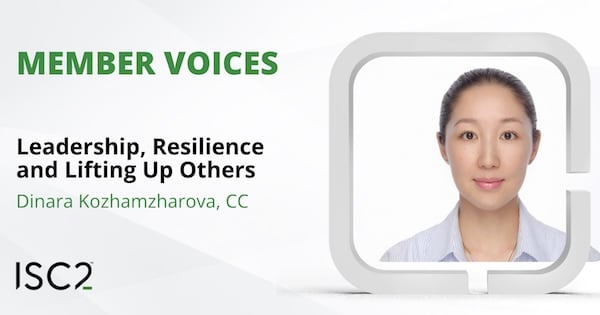
Dinara Kozhamzharova, CC, has seen firsthand how access to mentorship and professional networks can transform confidence and career trajectories. Here she offers advice to any cybersecurity practitioner, or to someone considering joining the profession, to get involved with communities and the mentors you will find in them.
 Disclaimer: The views and opinions expressed in this article belong solely to the author and do not necessarily reflect those of ISC2.
My journey into cybersecurity was driven by curiosity, responsibility and a growing awareness of how deeply technology affects people’s lives. I began my academic path in computer science and engineering, working on complex systems such as multi-agent technologies and autonomous platforms. During my PhD internship I worked on unmanned aerial vehicles (UAVs). I saw clearly how innovation and security are inseparable: every intelligent system depends on trust, while trust depends on security. That realization is what originally drew me into cybersecurity. It is what continues to motivate me today.
For many years, I taught computer networking, information security, and data protection at the International Information Technology University (IITU), strongly shaping my view of cybersecurity. Students often understand systems, protocols and architectures long before they understand risk, responsibility and real-world consequences. Helping them connect technical knowledge with impact – privacy, safety, and trust – became one of the most meaningful parts of my work and reinforced my belief that cybersecurity is ultimately about people, not just technology.
An Opportunity to Learn More
In 2018 I was awarded a “Bolashak” governmental scholarship, which enabled me to study advanced cybersecurity at the University of California, Los Angeles (UCLA). The result of that exposure – to global cybersecurity practices, advanced risk management approaches and interdisciplinary thinking – convinced me further that cybersecurity education must be practical, inclusive and grounded in real societal needs rather than purely technical theory. It is not a coincidence that, after completing my studies, I joined and led a national joint project with UNICEF Kazakhstan, Digital Literacy and Children’s Online Safety for Teachers and Parents.
A commitment to continuous professional development is an essential part of working in the cybersecurity profession, helping to strengthen personal leadership and develop ethical responsibility. To this end, certifications are important and I advise anyone entering the profession to view certifications as an important means of proving credibility and earning trust. I have an ISC2 Certified in Cybersecurity (CC) certification and am currently preparing for the CISSP certification.
Staying current in a fast-evolving field like cybersecurity also requires continuous engagement with research and professional communities, and I recommend this to anyone working (or considering working in) cybersecurity. In my case, multiple IEEE roles – including as an active member of IEEE Women in Engineering (WIE) – have helped me stay closely connected to emerging technologies, new research directions and innovative ideas while actively supporting the next generation of engineers.
A Matter of Professional Identity
Working in cybersecurity as a woman has inevitably shaped my professional identity. One of the most irksome realities of the field is how often I’ve been required to demonstrate expertise repeatedly, especially in security-critical discussions. These challenges are rarely explicit, but they demand resilience, consistency and confidence. However, I’ve also seen and experienced real and encouraging progress. Today, more women are leading cybersecurity initiatives, participating in policy discussions and shaping professional standards. This progress gives me genuine optimism.
Community support has played a defining role throughout my career. I believe it’s important both to ‘give back’ and to be a role model for other women. I duly work with Women in Cybersecurity Kazakhstan, where we focus on mentorship, awareness and professional growth for girls and women entering cybersecurity. We help women navigate career paths, overcome self-doubt and recognize that they truly belong in this field. I also serve as a Women in Tech Kazakhstan member, working to build sustainable partnerships between academia, industry, startups and international organizations. We seek to create meaningful opportunities for women to grow professionally in technology and science.
Community Participation
I also engage with the global WiCyS community, through which women gain access to mentorship programs, webinars, technical tournaments, career hubs, job opportunities and high-quality knowledge-based content. I’ve seen firsthand how access to mentorship and professional networks can transform confidence and career trajectories, so it will surprise no-one that my advice to any cybersecurity practitioner, or to someone considering joining the profession, is to get involved with such communities, and the mentors you will find in them.
The growing availability of support networks and this growing sense of collective responsibility fills me with optimism for the future for women in cybersecurity. Women are not only entering the field they are shaping education, influencing policy, building communities and supporting one another across borders. When we lift each other up, we strengthen not only individual careers, but the cybersecurity profession as a whole.
Dinara Kozhamzharova, CC, has more than 17 years of experience in academia, cybersecurity, digital governance and STEM leadership. She has held academic leadership and strategic management roles, with responsibility for curriculum development, international partnerships, cybersecurity education and research initiatives. Her work spans information technology, networking, AI, capacity building and the advancement of women in technology leadership.
Global 50x50 Women’s SummitTaking place on March 18, 2026, the Global 50x50 Women’s Summit is a virtual event which will bring together women and allies from every corner of the cybersecurity ecosystem to explore how inclusive leadership, intentional sponsorship, and meaningful mentorship open doors to opportunity and reshape the talent pipeline. Supported by ISC2 and The Centre for Cyber Safety and Education, this event builds on the work of the Global 50x50 Initiative towards a future where women make up 50% of the cyber workforce by 2050. The Summit will highlight the actions needed to create a more resilient and sustainable cybersecurity workforce for all. By attending this live event, you are eligible to receive 3.5 CPE credits. Additional credits can also be earned with on-demand viewing. |
.png?h=420&iar=0&w=420)
.png?h=420&iar=0&w=420)