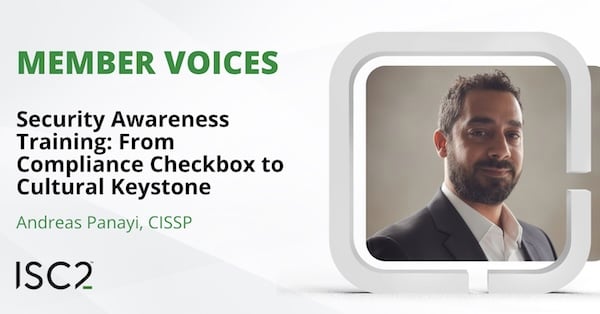
Nine years in cybersecurity have taught Andreas Panayi, CISSP one clear truth: security awareness training is often treated as a compliance checkbox exercise that needs to change.
 Disclaimer: The views and opinions expressed in this article belong solely to the author and do not necessarily reflect those of ISC2.
When I first faced the challenge of rolling out a new security awareness program, the odds seemed stacked against success. Our workforce was diverse, spanning multiple languages and skill levels. Imagine explaining sophisticated cyber threats to someone who doesn’t speak English, to a developer and to a data-entry clerk, simultaneously, using the same generic module. The go-to approaches – of sending generalized emails or having the same organization-wide presentation for everyone – wasn’t just ineffective; it was alienating.
So… we flipped the script.
The Turning Point: Inclusion as a Strategy
The first breakthrough came when we embraced inclusion - not as a buzzword but as a design principle. Training was configured to be accessible to practically everyone in the company, regardless of language or technical background. Micro-learning modules replaced long presentations, and interactive content replaced passive slides. Suddenly, cybersecurity wasn’t an intimidating lecture; we had made it into a relatable, bite-sized experience.
Here’s the first encouraging fact: staff who had resisted other initiatives were among the first to adopt our platform. Yes: the very people we expected to push back became early champions. Why? Because the training spoke their language, literally and figuratively.
Humor as a Trojan Horse
The second surprise was how humor transformed the conversation. We embedded lighthearted, humorous content into the modules. Our intention by doing so was not to trivialize security, but to humanize it. Jokes about phishing scams and playful scenarios have turned what was once a dry topic into something employees actually talk about: cybersecurity training has become a conversation starter in break rooms and chat threads. That cultural ripple effect has been priceless.
Engagement Beyond Compliance
Of course, customization remains key. Developers get advanced threat detection tips, while administrative teams learn how to spot phishing attempts. Executives see security through the lens of business risk.
Employing gamification in training and running frequent phishing simulations has added a competitive edge, which has acted as a catalyst for active engagement of staff. To avoid death by PowerPoint, users are from time to time asked to play mini-games that still provide the knowledge and information we want to deliver. Badges are sent from the awareness training platform to the stable and high performers. Micro-learning has made it easy to fit training into busy schedules.
Our results speak volumes: an average of over 95% of staff complete their training on time and engagement metrics have soared. More importantly, employees feel empowered, not lectured. They understand the “why” behind the “what,” and that understanding has become the all-important foundation of a security-first culture.
The Bigger Lesson
My experiences have reinforced a critical truth: there is no universal cybersecurity training solution. Every organization needs a tailored approach that respects its unique culture and diversity. By prioritizing inclusion, engagement and continuous reinforcement, we haven’t just checked a compliance box – we’ve built resilience.
And resilience, in today’s threat landscape, is everything.
Andreas Panayi, CISSP, has nearly a decade of experience in cybersecurity, with both hands-on and managerial involvement across all security layers typically found in a secure environment. He focuses on fostering collaboration and securely aligning technology initiatives with organizational goals.